

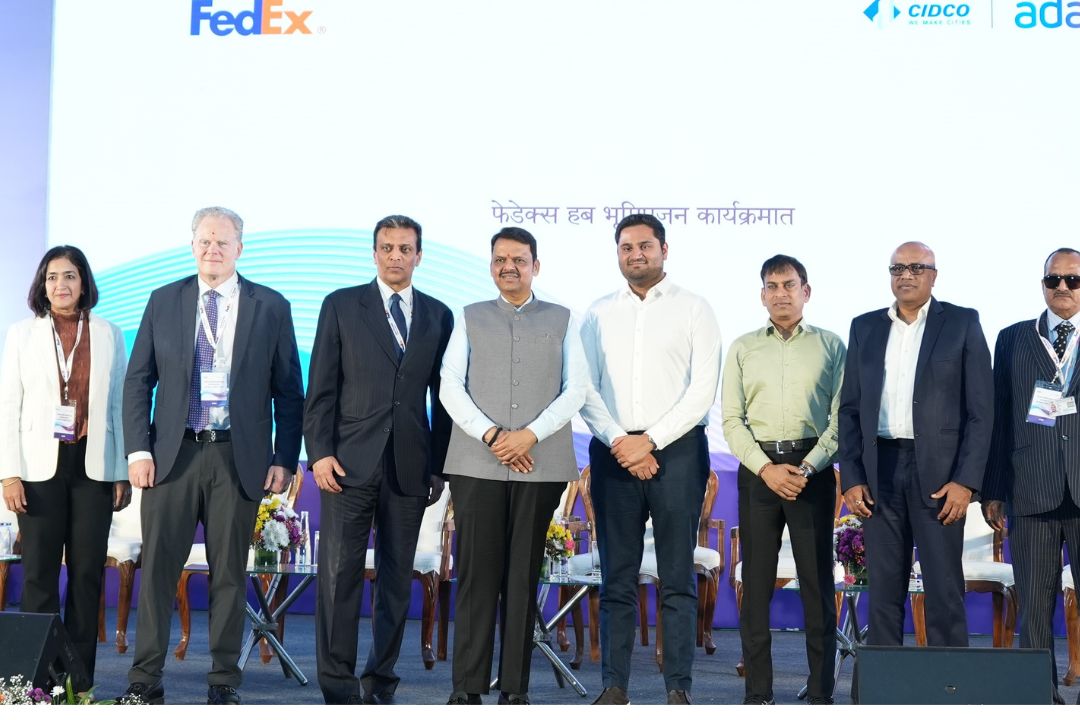
FedEx has commenced construction of a fully automated air cargo hub at Navi Mumbai International Airport (NMIA), marking a major step in expanding cargo capacity along India’s busiest international trade corridor and reinforcing Western India’s position as a key logistics gateway. The project represents a long-term investment of ₹2,500 crore and will deliver a 300,000 sq ft facility developed in partnership with Adani Airport Holdings Ltd. (AAHL).
Designed as a regional consolidation and redistribution hub, the facility will leverage NMIA’s multimodal connectivity to support faster and more efficient cargo movement. Once operational, the hub is expected to generate over 6,000 direct and indirect jobs across logistics, warehousing, transportation and allied services.
The ground-breaking ceremony was attended by the Honourable Chief Minister of Maharashtra, Devendra Fadnavis, along with senior leadership from FedEx and AAHL, including Raj Subramaniam, President and CEO, FedEx; Richard Smith, CEO, Airline and COO, International, FedEx; Kami Viswanathan, President, FedEx Middle East, Indian Subcontinent and Africa; and Jeet Adani, Director, AAHL.
Jeet Adani said the development aligns with NMIA’s long-term objective of building integrated infrastructure to enhance India’s trade competitiveness. He highlighted the airport’s proximity to Jawaharlal Nehru Port, industrial corridors and transport networks as a key advantage for supporting export-led growth.
The hub will feature automated sorting systems, dimensional scanning, high-speed security screening and dedicated aircraft parking bays, enabling parallel handling of inbound and outbound shipments. This infrastructure is expected to improve routing flexibility and transit reliability for time-sensitive sectors such as electronics, engineering goods, pharmaceuticals and perishables, while also supporting MSME exporters.
NMIA’s cargo operations are planned to begin with an annual handling capacity of about 0.5 million metric tonnes, scaling to nearly 3.25 million metric tonnes in later phases, positioning the Mumbai Metropolitan Region as one of India’s most advanced air freight hubs. Federal Express Corporation is the world’s largest express transportation company, offering time-definite delivery services across more than 220 countries and territories. Through its integrated global air and ground network, the company ensures fast, reliable movement of time-sensitive shipments, connecting businesses and markets worldwide with precision and efficiency.
Navi Mumbai International Airport Private Limited (NMIAL) is the special purpose vehicle formed to develop, construct, operate and maintain the greenfield airport project at Navi Mumbai, Maharashtra. The project is structured as a Public Private Partnership between Mumbai International Airport Limited (MIAL), a subsidiary of Adani Airports Holdings Limited holding a 74 percent majority stake, and City and Industrial Development Corporation of Maharashtra Limited (CIDCO), a Government of Maharashtra undertaking, which holds the remaining 26 percent.
AAHL is a subsidiary of Adani Enterprises Ltd, the flagship incubator of the Adani Group. Navi Mumbai International Airport (IATA: NMI; ICAO: VANM) is poised to emerge as one of India’s most important aviation hubs. Strategically located in Navi Mumbai, Maharashtra, the airport is designed to address rising air traffic demand across the Mumbai Metropolitan Region and Western India.
Spread across approximately 1,160 hectares (2,866 acres), NMIA is planned to handle up to 90 million passengers annually upon full completion. The airport will feature two parallel runways, advanced terminal infrastructure and modern cargo facilities to enable efficient passenger and freight operations. Developed as a sustainable greenfield airport, NMIA incorporates renewable energy integration and environmentally responsible design, with architectural elements inspired by the lotus, India’s national flower. In its first phase, the airport will manage 20 million passengers per annum and 0.5 million metric tonnes of cargo, setting new standards in operational performance, sustainability and passenger experience.









