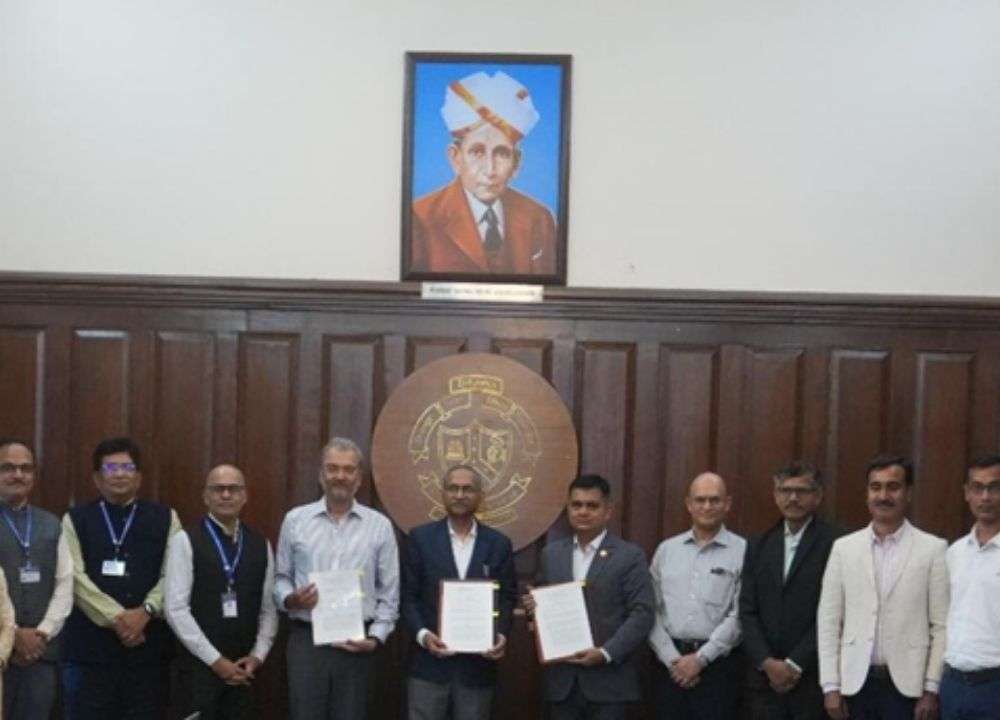
COEP Technological University (COEP Tech), Pune, and JSW Projects, a JSW Group company, have signed a Memorandum of Understanding (MoU) to establish an Advanced Battery Research & Development Centre at COEP Tech’s Chikhali Research Park. The project will focus on indigenous battery technology development, with a combined investment of more than ₹800 crore across two phases.
The centre is planned as a battery prototyping and pilot-scale research and development platform, bringing lithium-ion cell development into an academic campus. COEP Tech faculty and students will work with JSW engineers on cell design, testing, validation and related research, creating an industry-academia platform for battery technology development.
Phase I will establish a Cell Research & Development Centre for designing, simulating and prototyping lithium-ion and other advanced chemistry cells, including sodium-ion technology. Phase II will expand the facility into a Cell Validation Centre capable of producing cells in the 100-600 Ah range.
The batteries developed through the centre will be designed for Indian climatic conditions and applications, with the objective of achieving performance comparable with global products. The facility will also support joint research, technical projects, publications and intellectual property development.
Prof. Sunil Bhirud, Hon’ble Vice Chancellor, COEP Technological University, said, “This collaboration has the potential to create a strong indigenous alternative to imported batteries and make a significant contribution to India’s journey towards self-reliance. For students, it will provide a unique opportunity to learn and work on cutting-edge battery technologies. The scale and scope of the Phase I and Phase II collaboration between COEP Technological University and JSW make it a landmark industry-academia initiative.”
Sajjan Jindal, Chairman, JSW Group, said, “Cell is the new oil. Just as oil powered the last century, battery cells will power this one, from electric vehicles to the grid. For decades, India has spent precious forex importing oil. This time, we must build the cutting-edge skills and capabilities to make these cells right here, for a new India. Our partnership with COEP Tech, with its 170-year legacy of engineering excellence, will bring industry and academia together to design, test and validate cells built for Indian conditions, and help shape India’s clean energy future.”
The initiative is aligned with JSW Group’s activities in electric mobility and grid-scale battery energy storage. JSW Motors is expanding its electric vehicle business, while JSW Energy is developing battery energy storage capacity alongside its renewable power operations.
The centre is expected to support the development of a domestic battery ecosystem and could catalyse more than 1,000 jobs across related activities. COEP Tech and JSW said the initiative will also support India’s efforts to build domestic capabilities in battery technology for electric mobility, energy storage and clean-energy applications.
Established in 1854, COEP Technological University (COEP Tech), formerly known as the College of Engineering Pune, has a history spanning more than 170 years. It was founded as the Poona Engineering Class and Mechanical School to train officers for public works, including the construction of buildings, dams, canals, railways and bridges. The institution was renamed several times before becoming the College of Engineering, Poona, in 1911.
COEP was initially affiliated with the University of Bombay for the Licentiate in Civil Engineering (LCE) programme and was later affiliated with the University of Pune. Degree programmes in Civil Engineering, Mechanical Engineering and Electrical Engineering were introduced in 1908, 1912 and 1932, respectively. Over the years, the institution expanded its academic programmes, departments and research capabilities. Today, COEP Tech is a leading technical institution with a long-standing focus on engineering education, research and innovation.
JSW Group is an Indian business group with operations across steel, energy, infrastructure, cement, paints, defence, automobiles, e-commerce, sports, real estate and venture capital. Its flagship company, JSW Steel, has grown from a single manufacturing unit into an integrated steel producer with a consolidated crude steel capacity of 35.7 MTPA, including 1.5 MTPA in the US. Its domestic crude steel capacity stands at 34.2 MTPA, including 5 MTPA under commissioning, with the company planning to increase consolidated capacity to 43.5 MTPA over the next three years.
JSW Steel’s Vijayanagar plant in Karnataka has a current capacity of 17.5 MTPA, including 5 MTPA under commissioning, making it the company’s largest manufacturing facility. JSW Steel has a strategic collaboration with Japan’s JFE Steel to access technologies for the production of high-value special steel products.
The company is also pursuing measures to reduce the environmental impact of its operations. JSW Steel aims to reduce CO2 emissions from its steel-making operations by 42% by 2030 and achieve net-zero carbon emissions from operations under its direct control by 2050. It also plans to transition its steel-making operations to renewable energy by 2030.