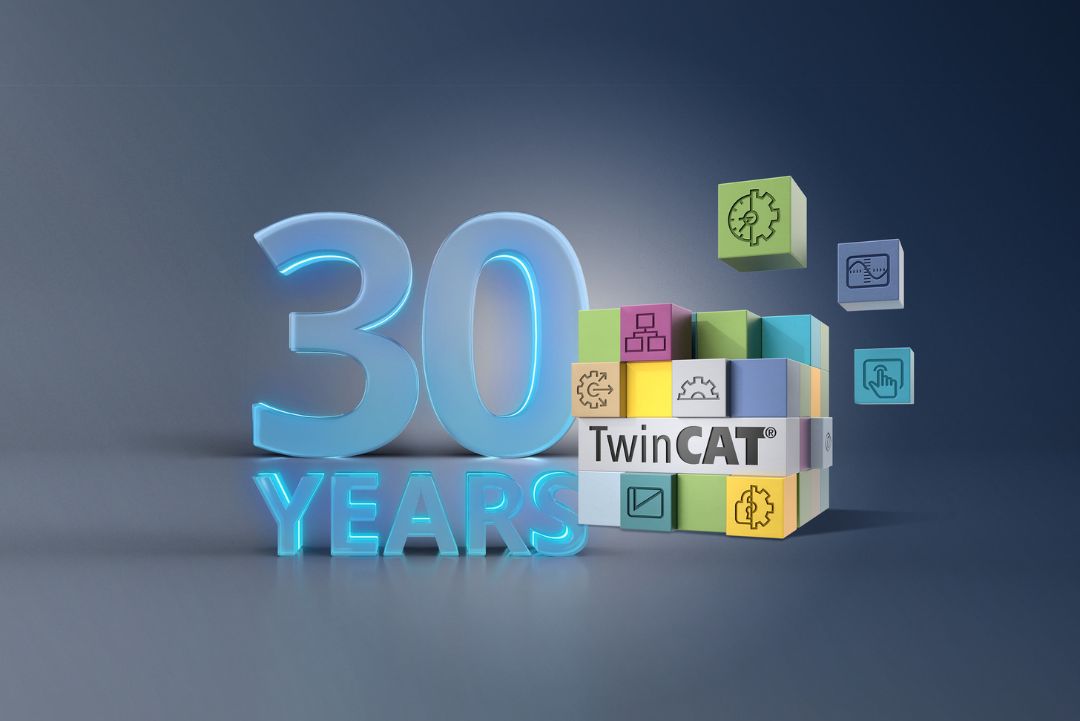
Beckhoff Automation is marking three decades of TwinCAT, the software platform that helped redefine industrial automation through PC-based control technology. Since its launch in 1996, TwinCAT has evolved into a comprehensive automation platform that integrates PLC, motion control, CNC, robotics, machine vision, measurement technology, and artificial intelligence within a single deterministic real-time environment.
The introduction of TwinCAT represented a major milestone in automation engineering. By transitioning from DOS to Windows-based architecture and adopting programming in accordance with IEC 61131-3 standards, Beckhoff created a flexible and scalable system that separated hardware from software. This approach enabled manufacturers to move beyond the limitations of proprietary control hardware and adopt a more open, software-driven model for machine control.
TwinCAT also enabled the integration of established IT technologies into industrial automation. Alongside IEC 61131-3 programming languages, the platform supports widely used standards such as C, C++, MATLAB, and Simulink, creating a unified engineering environment for developers and machine builders worldwide.
From its earliest versions, TwinCAT delivered high-speed performance with PLC cycle times as low as 100 microseconds and significantly expanded memory capabilities. Motion control functionality advanced rapidly, supporting everything from standard axes and electronic cam plates to sophisticated 5-axis CNC applications. Over time, the platform expanded from controlling a few axes to managing more than 1,000 synchronized axes while simultaneously reducing system costs per axis.
Today, TwinCAT includes more than 100 specialized automation functions. All machine operations are processed deterministically on a central industrial PC and synchronized through the high-speed EtherCAT fieldbus system. This architecture enables highly precise control, faster response times, and reduced installation complexity while lowering space requirements inside control cabinets.
The platform has also expanded into advanced technologies such as machine vision and robotics through native runtime modules including TwinCAT Vision and integrated robot control. Artificial intelligence is becoming another key focus area. The TwinCAT Machine Learning Creator allows users to develop AI models for image analysis, anomaly detection, and process monitoring without requiring advanced data science expertise. In addition, the TwinCAT CoAgent assistance tool supports users from engineering through live machine operation.
With increasing convergence between IT and operational technology, TwinCAT continues to provide a scalable and future-ready framework for industrial automation. Its compatibility with cloud and edge infrastructures, support for emerging communication standards, and adaptability to evolving cybersecurity requirements position the platform to meet the demands of next-generation manufacturing and intelligent automation systems.