

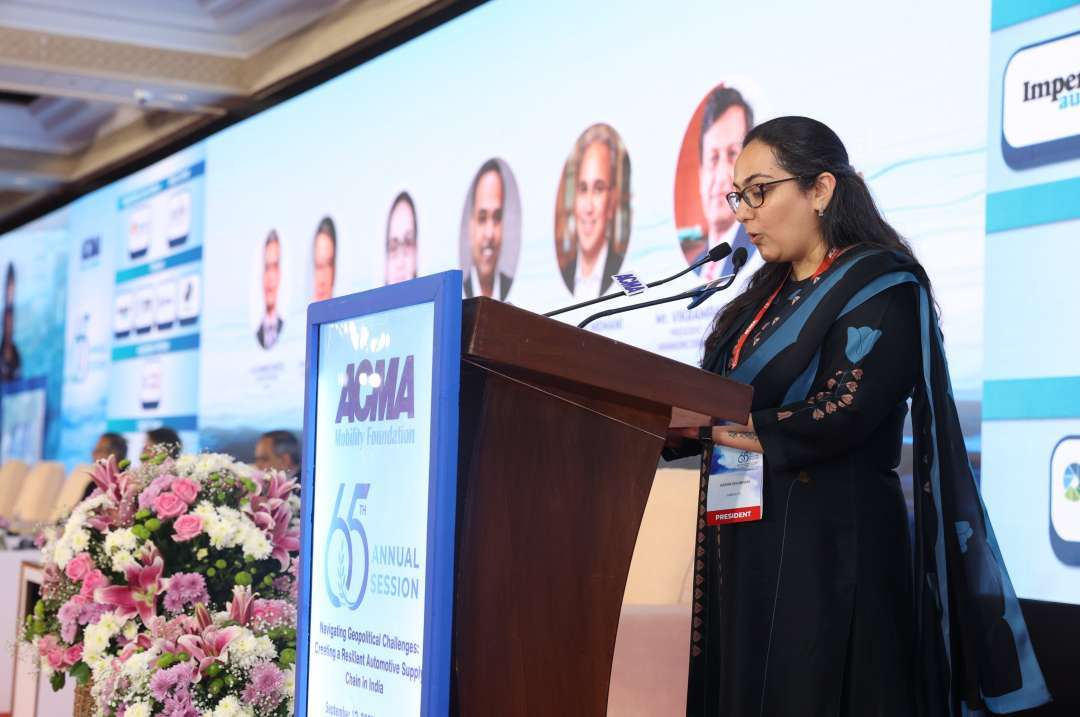
Auto industry bodies on Friday emphasized the need for closer cooperation with the government to ensure access to critical raw materials, including rare earth magnets, and advanced technologies amid changing geopolitical dynamics and new trade agreements. The industry is united in its determination to turn challenges into opportunities and establish India as a reliable and competitive global hub for mobility components, while building a resilient automotive supply chain, said Shradha Suri Marwah, President of the Automotive Component Manufacturers Association of India (ACMA).
Speaking at ACMA’s annual session, she stated, “The availability of critical raw materials like rare earth magnets, semiconductors, and battery inputs is becoming a strategic issue that demands national attention.”
Ms Marwah added, “We are at a crossroads where opportunities are significant, but challenges are formidable. Geopolitical volatility, trade wars, tariff increases, and export restrictions are reshaping global supply chains.”
Looking ahead, she said, “Closer partnerships with the government are essential to secure critical raw materials, strengthen international alliances for access to new markets, and enhance the competitiveness of our industry.”
Echoing similar sentiments, Shailesh Chandra, President of the Society of Indian Automobile Manufacturers (SIAM), highlighted the need for supply chains to move beyond cost efficiency and become more agile, diversified, and resilient to disruptions.
“This calls for actively developing alternative supply chains by collaborating with countries rich in resources,” he said. Mr Chandra further explained, “While business-to-business relationships are crucial, government intervention in both partnering countries must act as a catalyst to build stronger alliances.”
These partnerships should leverage each country’s strengths, whether in raw material availability or technological capabilities, he added. Over recent years, Mr Chandra observed, “The global trade and manufacturing landscape has undergone significant transformations.”
“Shifting geopolitical alignments, evolving trade agreements, and rapid technological changes have collectively reshaped the functioning of supply chains,” he noted. He concluded by stating that India’s automotive industry, deeply connected with global networks, is both affected by and actively adapting to these changes.
Founded in 1959, the Automotive Component Manufacturers Association of India (ACMA) is the leading organization representing India’s auto component industry. With over 800 members, ACMA plays a central role in aligning manufacturers, distributors, and exporters with industry standards, technological advancements, and regulatory frameworks, serving both domestic and international markets.
ACMA’s activities focus on policy advocacy, technology support, and market development, aiming to enhance the competitiveness of the sector globally. It works closely with government agencies to shape policies that promote innovation and growth in the automotive component industry. ACMA also organizes trade shows, conferences, and events like iAutoConnect, which facilitate partnerships between Indian manufacturers and global buyers.
In addition, ACMA supports its members with training and technical assistance in areas like quality control, innovation, and sustainability. Through these initiatives, ACMA contributes to India’s “Make in India” campaign, positioning the country as a preferred source for automotive components.









