

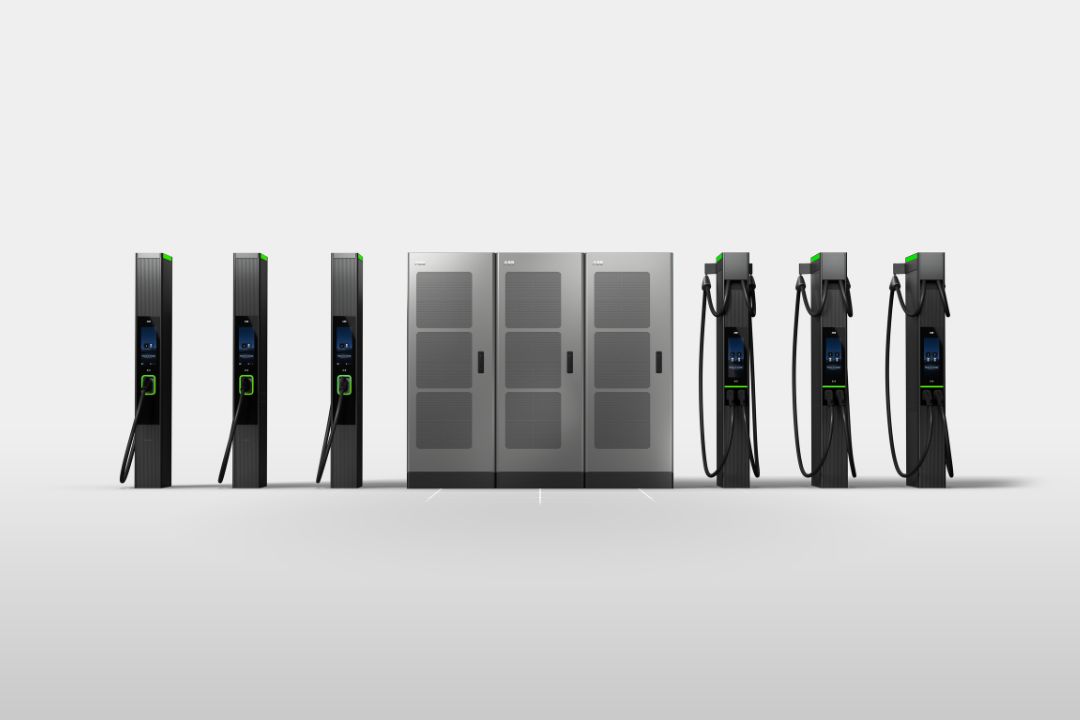
ABB E-mobility has unveiled its OM M-Series, a modular charging architecture designed to align electric vehicle (EV) infrastructure with the economics of delivered energy. The launch reflects a broader shift in the EV charging sector, where operators are increasingly focused on energy delivery efficiency and site-level performance rather than installed capacity alone.
The M-Series introduces an air-cooled split-system design that separates power units from charging dispensers. This approach enables operators to configure charging infrastructure based on specific use cases, rather than deploying standardized systems. Centralized power cabinets are connected to a flexible range of ChargePost dispensers, supporting multiple charging standards including CCS1, CCS2, NACS, and MCS, and allowing deployment across a wide range of site configurations.
Michael Halbherr, Chief Executive Officer of ABB E-mobility, stated that the industry is moving beyond maximizing nominal power capacity toward optimizing the cost and efficiency of energy delivered over a site’s lifecycle. He noted that consistent and efficient power delivery across varying demand conditions is becoming the defining factor in infrastructure performance.
At the core of the M-Series is a shared power architecture that dynamically allocates energy across multiple charge points based on real-time demand. This design allows operators to reduce total installed power while maintaining high output levels during peak usage, improving both operational efficiency and cost management.
The system is scalable from 200 kW to 1.2 MW and can support up to 24 charging points. Capacity can be expanded in 400 kW increments through interconnected cabinets, enabling infrastructure growth without requiring major redesigns. This modularity supports investment decisions aligned with actual demand rather than projected usage.
With a high power density footprint, the M-Series enables greater capacity within limited space, addressing constraints often faced in urban and high-cost locations. The system is also designed to maintain power delivery levels close to rated capacity across different vehicle types, ensuring effective utilization of installed infrastructure.
The M-Series is suited for multiple deployment scenarios, including public fast-charging corridors, retail and hospitality locations, and commercial fleet depots. Its flexible architecture supports varying usage patterns, from high-power rapid charging to lower-power overnight charging, without the need for separate systems.
Integration with ABB E-mobility’s digital platform enables real-time monitoring, predictive maintenance, and operational insights. The system also supports battery integration for energy management and includes open interfaces for compatibility with third-party platforms.









