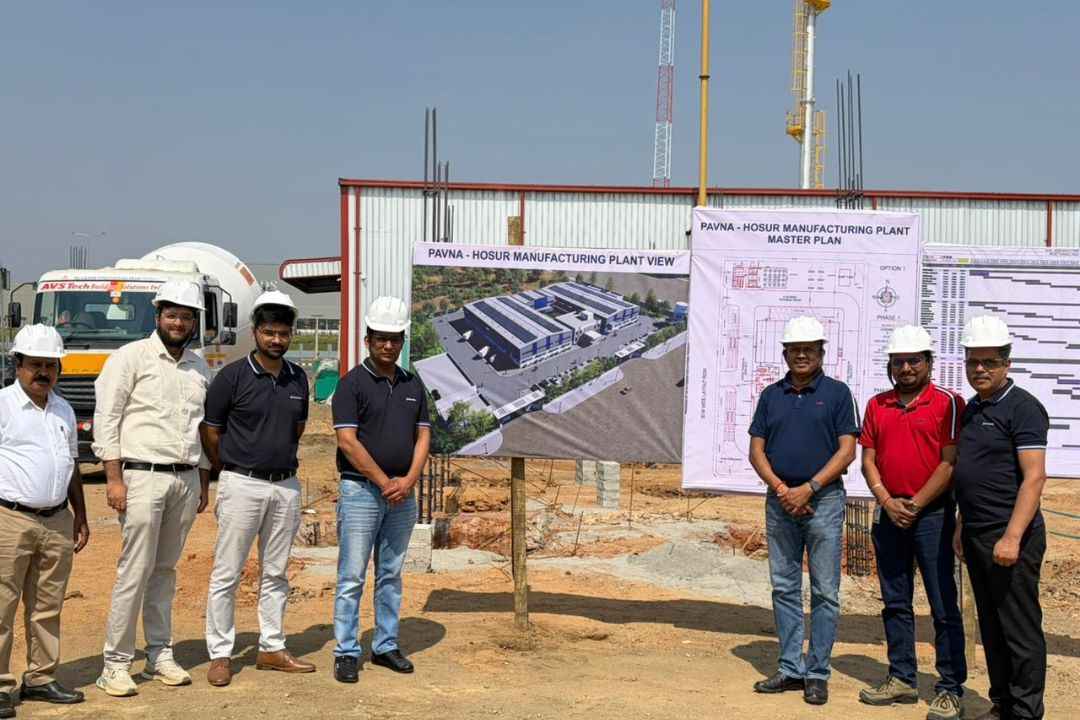
Pavna Industries Limited (NSE: PAVNAIND | BSE: 543915), a prominent manufacturer of automotive components serving multiple vehicle categories, has marked an important milestone with the commencement of construction at its upcoming manufacturing facility in Hosur, Tamil Nadu.
The ceremonial groundbreaking signals the start of a new phase of expansion for the company, reflecting its focus on strengthening manufacturing capabilities, expanding its footprint in southern India and aligning capacity with the evolving requirements of the domestic automotive sector. The new facility is designed to support Pavna’s long-term growth ambitions by enhancing operational scale and proximity to key customers.
Located in Hosur, one of southern India’s major automotive and industrial hubs, the plant benefits from its close access to several leading original equipment manufacturers. This strategic location is expected to improve supply chain responsiveness, reduce logistics lead times and support closer collaboration with customers across the region.
The initial phase of the Hosur project will involve a capital investment of approximately ₹50 crore. In its first stage, the facility will focus on the production of select critical automotive components, with plans to progressively scale capacity in line with market demand. Commercial operations at the plant are scheduled to begin later in 2026.
The expansion is also expected to contribute positively to the local economy by supporting employment generation and strengthening the regional manufacturing ecosystem. By establishing a presence in Hosur, Pavna Industries aims to enhance its ability to serve customers across passenger vehicles, two-wheelers, three-wheelers, commercial vehicles and off-road vehicle segments more efficiently.
Commenting on the development, Swapnil Jain, Managing Director of Pavna Industries Limited, said the groundbreaking represents a pivotal moment in the company’s growth trajectory. He noted that the Hosur facility reflects Pavna’s commitment to customer proximity, operational excellence and dependable supply. He added that the investment would strengthen production capacity, improve logistics efficiency and support the company’s broader objective of sustainable expansion.
Founded on April 19, 1994, Pavna Industries Limited—earlier known as Pavna Locks Limited—has built a strong reputation in South Asia’s automotive landscape. The company specializes in precision-engineered components for renowned OEMs across multiple vehicle platforms including passenger cars, motorcycles, scooters, three-wheelers, heavy and light commercial vehicles, and specialized off-road equipment. Its legacy of manufacturing excellence and innovation spans more than five decades. The company operates modern production centers in Aligarh (Uttar Pradesh), Aurangabad (Maharashtra), and Pantnagar (Uttarakhand), enabling close coordination with leading OEM customers and ensuring quicker turnaround in deliveries and product support.
Pavna’s extensive product suite includes ignition systems, tank caps, mechanical and electronic locking solutions, oil pumps, throttle bodies, switches, fuel cocks, and precision cast components. Beyond a strong domestic network, the company exports to international markets including Italy, Sri Lanka, Indonesia, Sudan, the United States, and Bangladesh. Its customer portfolio features major industry names such as Bajaj, Honda, Kawasaki, TVS, Escorts, Royal Enfield, Mahindra group companies, Ashok Leyland, Eicher Motors, Tork Motors, Revolt, and others.
Technology-led advancement remains a core strength for Pavna Industries. The company continues to invest in R&D to enhance product diversity, improve performance, and modernize manufacturing. Its innovation programs include collaborations such as the Indo–Taiwan partnership with Sunworld Moto Industrial Co. Pavna Industries remains committed to strengthening its technological edge and addressing evolving customer needs through continuous improvement and global-standard engineering.