Inbolt and Universal Robots (UR), part of Teradyne Robotics, have announced the native integration of Inbolt’s 3D AI vision guidance software into Universal Robots’ Gen 7 robot platform. Announced at the SPS 2026 exhibition in Nuremberg, the integration enables manufacturers to deploy AI-powered vision guidance directly on the robot, without requiring a separate industrial PC.
Universal Robots’ seventh-generation robot family is designed to support AI applications at the industrial level. Inbolt is among the first UR+ partners to run an AI application directly on the platform’s CB7 Core controller, following the Gen 7 launch in September.
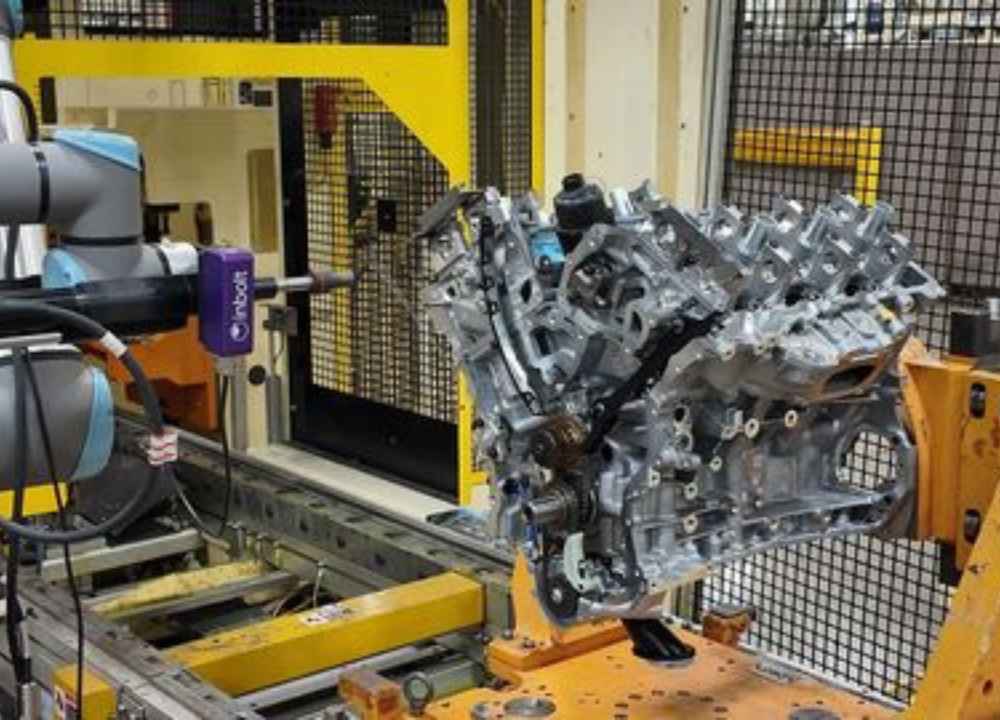
Inbolt Standard enables a UR robot to identify a component and adjust its programmed trajectory according to the component’s actual position during each production cycle. Applications include screwdriving, machine tending, rack loading and depalletising. A 3D camera mounted on the robot’s wrist recognises components using their CAD files, locates them and updates the robot’s taught path accordingly.
This approach reduces the need for manufacturers to develop customised jigs and fixtures for individual parts and workstations. When production requirements change, operators can introduce new part references through software rather than undertaking a tooling project.
By running natively on the CB7 Core controller, Inbolt Standard removes the external industrial PC traditionally required for vision-guided robot applications. This reduces system complexity and simplifies installation, deployment and ongoing support. Gen 7’s tool flange also features Ethernet connectivity and power connectors, allowing the Inbolt camera to connect directly to the robot. This eliminates the need to route camera cables along the outside of the robot arm.
Anders Billesø Beck, Vice President, AI Robotics Products at Universal Robots, said Gen 7 provides partners with the computing power, connectivity and development tools to build AI applications that operate directly on robots. He added that the Inbolt integration demonstrates how this approach can improve usability and reduce integration time, allowing manufacturers to make vision guidance a standard feature across production cells.
Universal Robots and Inbolt have collaborated since 2022, and their vision-guided robot systems are already operating at manufacturing facilities in Europe and North America. At a Stellantis engine-tightening station, Inbolt’s guidance technology reduced tightening failures by 91%, with vision processing taking just 0.5 seconds per engine.
Inbolt Standard supports stationary applications in which components arrive in repeatable orientations, including individual parts, layered racks and trays. Automotive applications include screwdriving, bolt run-down, de-racking, machine tending and layered depalletising.
The technology also supports automation in electronics and data centre hardware manufacturing, where trays, enclosures and server chassis may vary in position. Applications include tray and rack loading, fastening and torquing of assemblies. A single programme can handle more than 80 part references, while production teams can retrain the system when new components are introduced.
Rudy Cohen, Co-founder and CEO of Inbolt, said the integration brings the two companies’ products closer and allows manufacturers deploying collaborative robots across multiple production lines and facilities to include vision guidance from the outset. He added that Inbolt plans to introduce more of its product range to Universal Robots customers in the coming months.
Inbolt Studio, used to train parts and configure workstations, runs as a URCap application on PolyScope X. Part localisation is processed directly on the CB7 Core controller. An Orbbec 3D camera connects through the power and 1 Gb Ethernet ports in the g-Series tool flange.
The system can be trained locally using a component’s CAD file in under 10 minutes, without requiring image datasets or labelling. Production data remains within the facility. Inbolt commands are integrated into the PolyScope X programme tree and can be executed like other URScript instructions.
The system delivers repeatability of 0.5 to 0.7 mm on fixed parts. Its active infrared depth-sensing camera operates in bright, dim and dark conditions. Inbolt Standard runs natively on UR’s g-Series robots—UR10g-1750, UR17g-1300 and UR18g-950—with PolyScope X version 10.13 or later. It is also compatible with e-Series and UR Series robots equipped with a CB7 controller, using an external camera cable.
Inbolt develops AI-powered vision technology that enables robots to identify components and adapt their movements in real time. Its technology combines 3D vision and proprietary AI models for part localisation and robot trajectory control, including in unstructured environments and on moving production lines. The system can be trained using CAD models in minutes and is compatible with leading robot brands. Inbolt’s solutions are used in more than 100 factories worldwide by manufacturers including Stellantis, Toyota, Beko and Ford.
Universal Robots is a global supplier of collaborative industrial robots, with more than 100,000 cobots sold worldwide. Its platform is supported by PolyScope software, training programmes, services and a global ecosystem of partners and applications. The company develops collaborative robots and AI applications for a wide range of industrial sectors. Universal Robots is part of Teradyne Robotics, a division of Teradyne, Inc (NASDAQ: TER), a supplier of automated test equipment and advanced robotics systems.