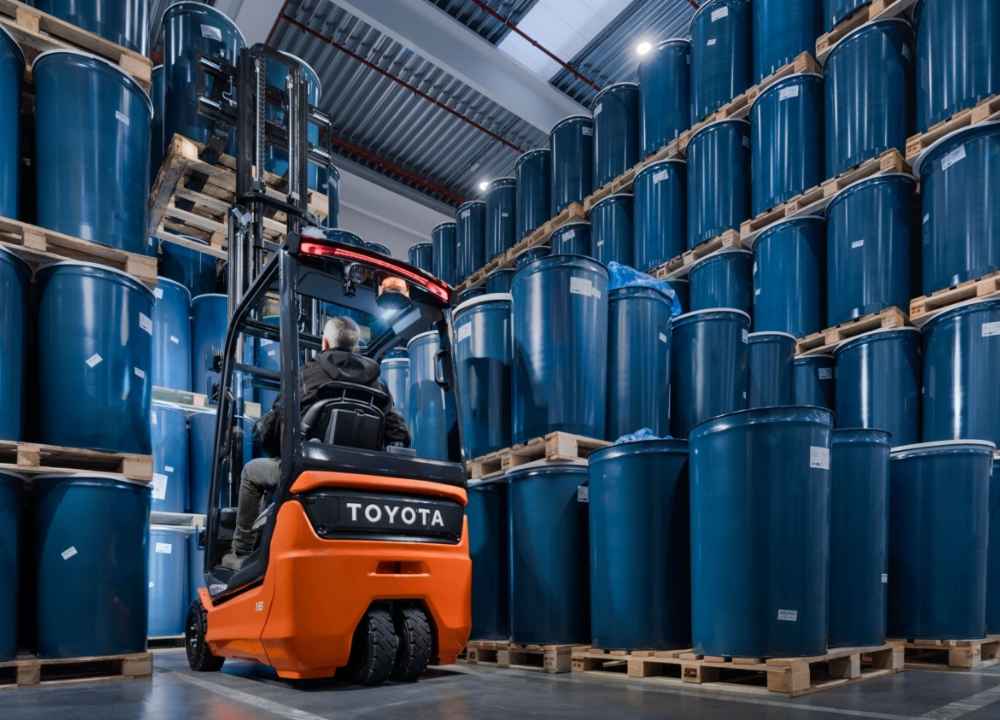
TYRI has partnered with Toyota Material Handling Europe (THME) on its Lower Carbon Series, a collaborative initiative examining how materials, product design and manufacturing processes can reduce the environmental impact of industrial vehicles. For the latest concept, based on Toyota’s Traigo48 electric counterbalanced forklift, TYRI has focused on reducing the carbon footprint of the vehicle’s rear light panel. The project brings together suppliers and technology partners to identify alternative materials and manufacturing methods that could be adopted in future production vehicles.
TYRI has worked with Toyota Material Handling Europe for several years. The company received the latest assignment approximately a year ago, with the objective of examining how lighting products could contribute to Toyota’s efforts to reduce the environmental impact of its equipment.
Since 2023, Toyota Material Handling Europe has developed several Lower Carbon concepts. The latest project builds on the Traigo48 forklift, for which TYRI already supplies a specially designed rear light panel. Ingrid Karlsson, Senior CMF (Colour, Material, Finish) Designer at Toyota Material Handling Europe and one of the project leaders, said the initiative aims to demonstrate the possibilities of lower-carbon product development and encourage wider adoption of suitable solutions. The company also intends to assess which technologies can be incorporated into future production vehicles.
TYRI’s work has covered three areas: recycled materials, alternative plastics and recyclable electronic components. For the rear light panel, TYRI evaluated the use of PCR and PIR recycled feedstocks in Dijblend 1000 D25. These materials offer the potential to reduce CO₂ emissions by up to 90% in selected applications.
The company also assessed SABIC Lexan 123R-111 as an alternative material, examining its environmental impact alongside the technical requirements of the lighting assembly. A third area of development involved Soluboard by Jiva, a recyclable printed circuit board (PCB) substrate made from natural fibres and a water-soluble polymer. According to Jiva, the material can reduce the carbon footprint by up to 67% compared with conventional epoxy-fibreglass PCB materials.
Christian Wadell, Global R&D Director at TYRI, said, “For us, the focus was the complex rear light panel. We looked at the complete product to see where alternative materials and technologies could make a difference.” He added that the project had encouraged the company to reconsider established product designs and examine materials and technologies that could eventually be used in series production.
The lighting solution is manufactured at TYRI’s facility in Gothenburg, Sweden, which operates using solar power and 100% fossil-free electricity. The Toyota Material Handling Europe Lower Carbon Concepts were presented at LogiMAT 2026, while the Traigo48 concept was also showcased at Milan Design Week 2026. The project highlights the role of component suppliers in reducing the environmental impact of industrial equipment through material selection, electronics design and manufacturing practices.
TYRI develops and manufactures lighting solutions for off-highway vehicles and industrial applications. The company works with vehicle manufacturers and equipment suppliers to develop lighting products suited to demanding operating environments, with a focus on product performance, design and manufacturing.