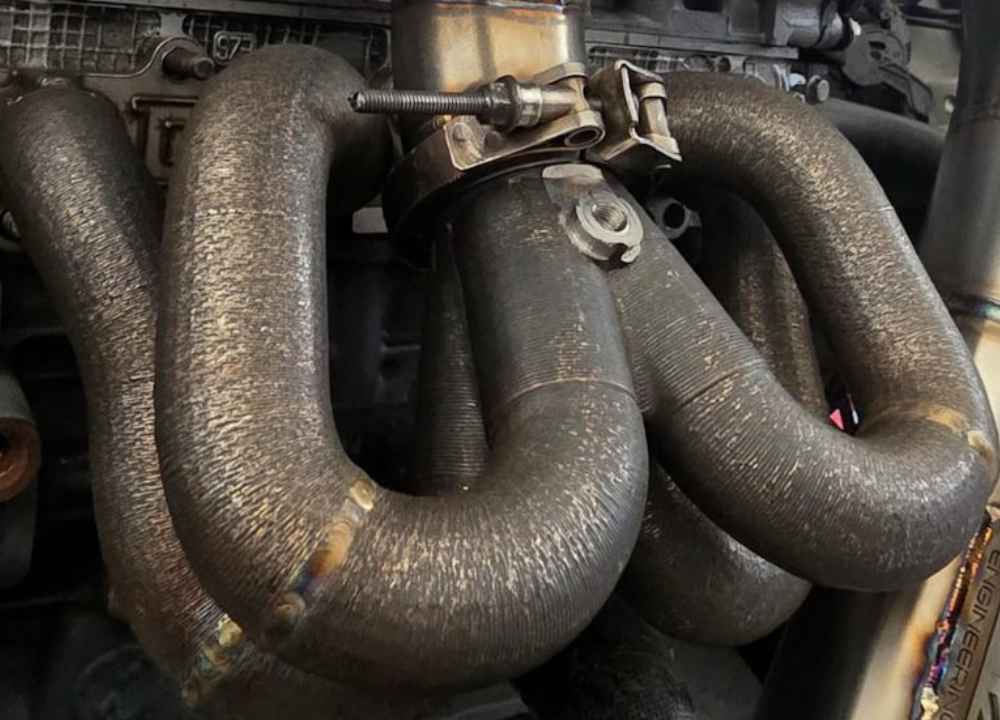
Meltio is showcasing real-world applications of its wire-laser metal 3D-printing technology at Formnext 2026, including a high-performance exhaust header developed by DMZ and installed in an Abarth 595 sports car. The component has completed approximately 10,000 kilometres on the road, including 600 kilometres on a race track, demonstrating the application of metal additive manufacturing in automotive engineering.
Visitors to Meltio’s booth, 12.0 C119, can see several metal components produced using the company’s technology, alongside live printing demonstrations. The showcased applications cover automotive, defence, mining, oil and gas, shipbuilding and aerospace, among other industries, where the technology is being used to manufacture and repair metal parts.
The DMZ exhaust header demonstrates how additive manufacturing can support complex component design while reducing production time. Developed to withstand high temperatures and mechanical stresses, the stainless-steel component features geometries designed to optimise exhaust gas flow in a combustion engine. Using Meltio’s directed energy deposition (DED) technology, DMZ reduced assembly time from eight hours to one hour. The exhaust system was installed in an Abarth 595 and tested over approximately 10,000 kilometres during a year of use, retaining its original condition.
Another automotive application involves reinforcing steel car wheels through the deposition of additional metal in selected areas. DMZ used Meltio’s technology to increase the stiffness of the steel wheel while retaining its weight advantage. The resulting design achieved the same natural frequency as an alloy wheel, combining improved structural performance with lower weight.
Meltio’s technology is also being used to address industrial maintenance challenges. In one application, IMET3D produced a replacement for an obsolete component after the failure of a critical centrifugal pump. Instead of replacing the entire system, the industrial customer used wire-laser metal 3D printing to recover the component through additive manufacturing.
The part was redesigned and manufactured by Meltio in stainless steel 316L, offering significantly improved corrosion resistance compared with the original cast-iron design. The approach enabled the recovery of an industrial asset when conventional spare parts were no longer available.
These applications demonstrate the use of wire-laser metal additive manufacturing for component production, design optimisation and repair. By enabling complex geometries, shorter manufacturing cycles and the local recovery of equipment, Meltio’s technology provides manufacturers and industrial operators with an alternative approach to metal part manufacturing and maintenance.