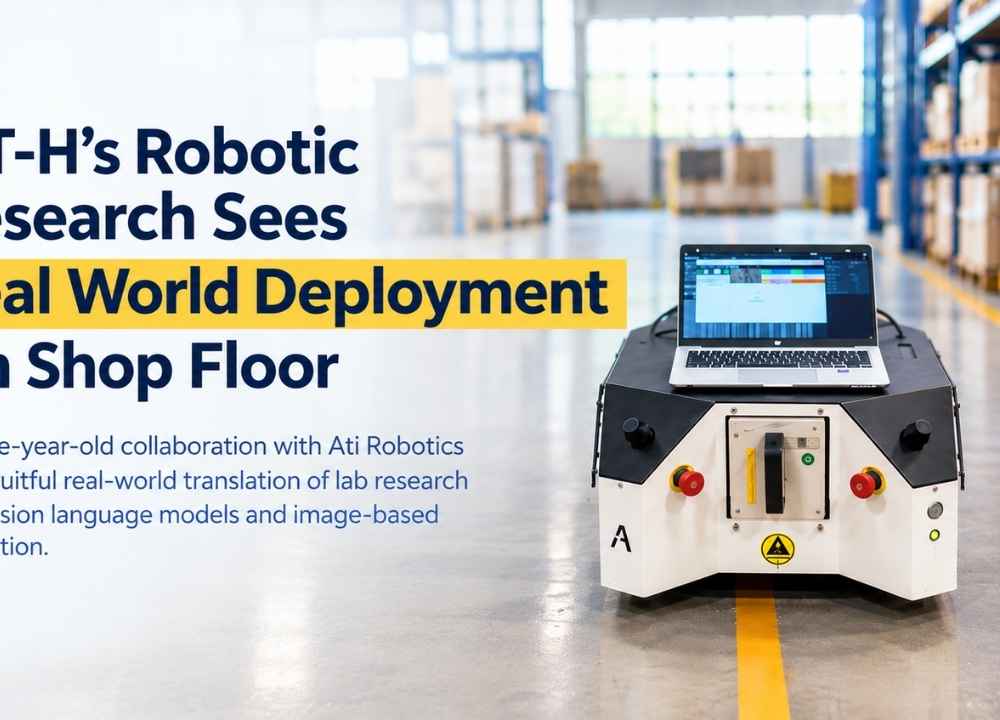
Research by the Robotics Research Center (RRC) at the International Institute of Information Technology Hyderabad (IIIT-H) is being tested in industrial settings through a three-year collaboration with Ati Robotics. The work focuses on enabling autonomous mobile robots (AMRs) to navigate using camera images and artificial intelligence rather than relying entirely on conventional LiDAR-based mapping.
A recent demonstration at Ati Robotics’ factory involved an AMR navigating to a specific object using a camera, images captured during an earlier walkthrough and a 3D foundational model. The robot operated without a LiDAR occupancy grid, scan-matched position estimates or a conventional metric map.
LiDAR systems help robots map their surroundings and determine their position through simultaneous localisation and mapping (SLAM). The IIIT-H team has been exploring alternative approaches that use visual information, familiar landmarks and image-based navigation to guide robot movement.
Professor Madhava Krishna explained that the research draws on how humans navigate by recognising objects and surroundings, remembering locations and adjusting routes when conditions change. Instead of constructing dense maps that require significant storage and computing resources, the researchers use sparse localisation, identifying recognisable features to estimate a robot’s position. In indoor environments such as warehouses, these features may include a doorway, an elevator or a particular storage area. The approach reduces the map to a smaller set of landmarks that can help the robot understand its surroundings.
The team has also examined image-based navigation, in which a destination is identified by selecting a point in an image rather than specifying precise coordinates. The AI model compares images of the same area, identifies corresponding points and estimates their three-dimensional relationships. It then develops a cost image to assess possible directions and guide movement towards the destination.
Professor Sourav Garg of the Robotics Research Center said the research began in 2023 with the question of how humans navigate using visual meaning, spatial relationships and local geometry. The team developed a navigation system covering mapping, localisation, planning and control through the relative connectivity of image segments.
The research has appeared at conferences including the IEEE International Conference on Robotics and Automation, the Conference on Robot Learning and the Annual Conference on Neural Information Processing Systems. IIIT-H has also transferred code to Ati Robotics for testing and deployment in warehouse robots.
Ati Robotics has adapted elements of the research for its own systems. The company is continuing to develop vision-driven navigation, with a focus on improving the final stages of robot movement, including docking, approaching pallets and entering narrow spaces. The collaboration demonstrates how academic robotics research can be adapted and tested for industrial use, while allowing the research team to continue developing camera-based navigation methods.