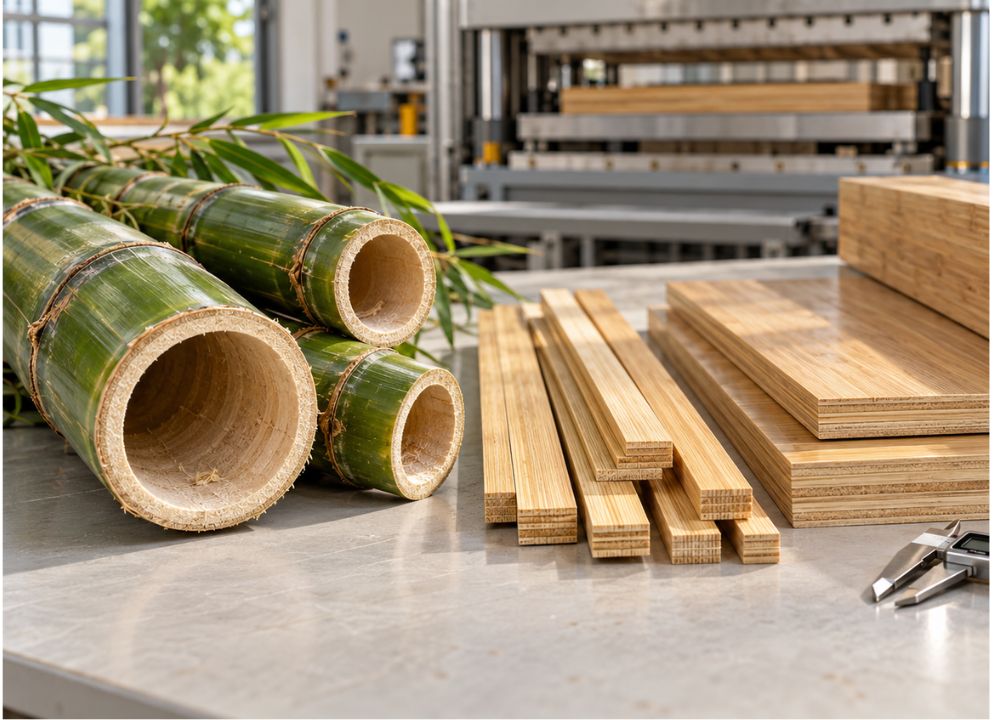
For decades, bamboo has been read as a low-tech material, useful for scaffolding and craft but not for anything that demands engineering rigour. That reputation was earned by raw bamboo, but that narrative is changing with time. It has little bearing on what engineered bamboo has become. Run through the same disciplined processing applied to structural timber, bamboo now enters conversations it was never previously invited into: structural flooring, load-bearing components, high-specification interiors. The distance between those two versions of the material is worth examining closely, because it explains why the industry’s old assumptions about bamboo cannot be justified any longer.
The Variance Problem
Raw bamboo cannot be specified against. Its strength shifts with species, age, growing conditions and even which culm on the same plant was harvested. Any industry built on predictable load-bearing performance has no use for a material this inconsistent, and that inconsistency is precisely what engineering exists to remove. Every claim engineered bamboo now makes about performance traces back to solving this one problem first.
Turning a Pole Into a Controlled Input
The transformation starts with strand or lamella preparation: bamboo culms split, flattened or shredded into uniform strips. This single step is what converts an unpredictable natural pole into a dimensionally controlled unit, and nothing that follows works without it.
Afterwards, those units are then carbonised and heat treated, a process that strips out the starch and sugar bamboo would otherwise offer to pests, while also tightening its dimensional stability against humidity. This is structural preparation, not surface treatment, and it is where engineered bamboo begins to earn its name.
Where Lamination Does the Real Work
Lamination under high pressure and heat is the point at which engineered bamboo stops behaving like a natural material and starts behaving like an industrial one. Layers of treated strips are bonded with grain orientation calculated for maximum strength, a method borrowed directly from engineered timber, yielding a composite whose density and compressive strength can match or exceed conventional hardwood.
The adhesive used in that bond matters more than most conversations about bamboo credit. Formaldehyde-free binding systems now shape both mechanical strength and indoor air quality, and the latter has moved from a niche preference to a procurement requirement across furniture and interior markets. Manufacturers who treat cure time, pressure and temperature as fixed rather than adhesive-specific are the ones whose panels fail to hold consistency batch to batch.
This is the same adhesive discipline that underpins engineered bamboo flooring in commercial interiors, structural panelling in modular construction, and worktop and cabinetry components in furniture manufacturing, applications that would not tolerate batch-to-batch variation.
Earning the Right to Be Tested Like Timber
Credibility in this category comes from refusing an easier standard. Engineered bamboo is now tested against the same protocols applied to structural timber and engineered wood panels: modulus of rupture, modulus of elasticity, density uniformity and moisture stability under accelerated humidity cycling. That decision, to be measured on conventional terms rather than a sustainability-adjusted curve, is what separates an industrial material from a well-marketed one.
What comes out the other side is no longer subject to the unpredictability of a single harvested pole. It behaves as a manufactured composite with defined mechanical properties and repeatable quality across batches, which is exactly what allows it to be specified with confidence rather than caution.
Why the Environmental Argument Is Not Enough on Its Own
Bamboo’s advantage over hardwood is not just directional, it is measurable. Certain species grow at rates approaching a metre a day during peak shooting season, and most commercial stands reach harvestable maturity in three to five years, a fraction of the decades most hardwood species require. Because bamboo is botanically a grass rather than a tree, it regenerates from the same rhizome system after each harvest instead of requiring replanting, and its dense root network has a documented capacity to bind soil and improve carbon retention in the soil profile. These are real advantages. They are also insufficient alone. Procurement decisions in industrial and architectural contexts are won on performance data, not sentiment. Categories that last are the ones that can defend both arguments simultaneously, and engineered bamboo has reached that point.
Documentation Is the Remaining Barrier
What procurement teams now expect, correctly, is the same paper trail required of any structural material: mill certifications, batch testing records, adhesive safety data sheets, third-party verification. Without that trail, architects and manufacturers are forced to treat bamboo as an exception requiring special justification, and that friction has held back adoption more than any real gap in performance. Where the documentation exists, the material has already proven itself at scale: engineered bamboo roof panels cover more than 200,000 square metres at Madrid’s Barajas Airport, and researchers at Nanjing Forestry University have spanned a 12-metre bridge in laminated bamboo lumber held together without metal fasteners.
What Comes Next As supply chains come under growing pressure to decarbonise without sacrificing durability, scrutiny of how raw agricultural materials get engineered into dependable industrial inputs will only sharpen. Engineered bamboo’s trajectory is a useful preview of that scrutiny, built on market evidence, rigorous testing, and a proven existence that, with proper technological advancements, bamboo can be another pillar of sustainable material, establishing itself among the giants like steel, iron & others.