

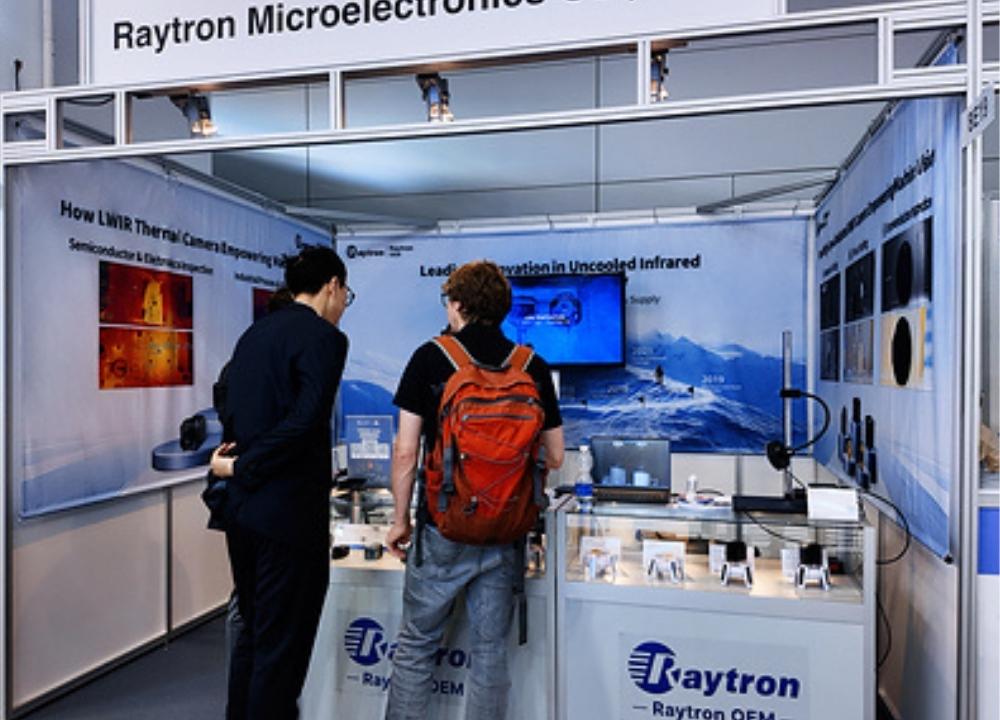
Raytron OEM showcased its short-wave infrared (SWIR) cameras and long-wave infrared (LWIR) thermal imaging modules at VISION 2026, held at Messe Stuttgart from October 6 to 8. The company demonstrated how infrared imaging technology can support industrial automation, machine vision, material inspection and temperature monitoring.
Live demonstrations showed how SWIR cameras could distinguish sugar from salt and identify differences between dry and wet biscuit samples. These applications demonstrated the potential of infrared imaging for material identification, food sorting and moisture detection in industrial production.
One of the key products on display was the NS-615AS-10GE SWIR camera, which offers a resolution of 640 × 512 pixels, a 10GigE interface and full-frame imaging at up to 825 frames per second. The camera is designed for high-speed image acquisition in applications such as semiconductor inspection and material sorting.
Raytron also presented the NS-615A-GE area-scan SWIR camera and the NS-101L2 line-scan SWIR camera. The two models offer different image acquisition formats and interface options, allowing manufacturers and system integrators to select equipment suited to their inspection requirements.
For developers looking to incorporate thermal imaging into their own products, Raytron displayed the SE5 1280 thermal imaging module. It provides a resolution of 1280 × 1024 pixels, a compact form factor and multiple digital interfaces. The WN2T Series temperature measurement modules were also featured. These modules combine non-contact temperature measurement with compact dimensions and low power consumption for industrial monitoring and inspection systems.
On October 8, Fushuai Liu, Head of Europe & Americas at Raytron, delivered a presentation titled “How Infrared Perception Is Shaping Industrial Machine Vision in Europe” during Industrial VISION Days. Drawing on the company’s EV Lithium-ion Battery Thermal Safety White Paper, he discussed battery safety, manufacturing quality and traceability in relation to the EU Battery Regulation.
Liu outlined a three-layer Thermal Vision framework covering thermal imaging hardware, data analysis and management, and integration with existing plant control and safety systems. Applications included the TN460U ultra-high-temperature thermal camera for battery safety testing and the TN430 and TN460 online thermal cameras for monitoring die-casting mould temperatures.
The framework supports continuous monitoring, tiered alerts and traceable thermal records across battery production, testing and storage. These capabilities can help manufacturers identify potential problems earlier and improve safety management. Through its product demonstrations and technical discussions at VISION 2026, Raytron OEM presented infrared imaging solutions for European manufacturers seeking to improve inspection, process monitoring and industrial automation.








