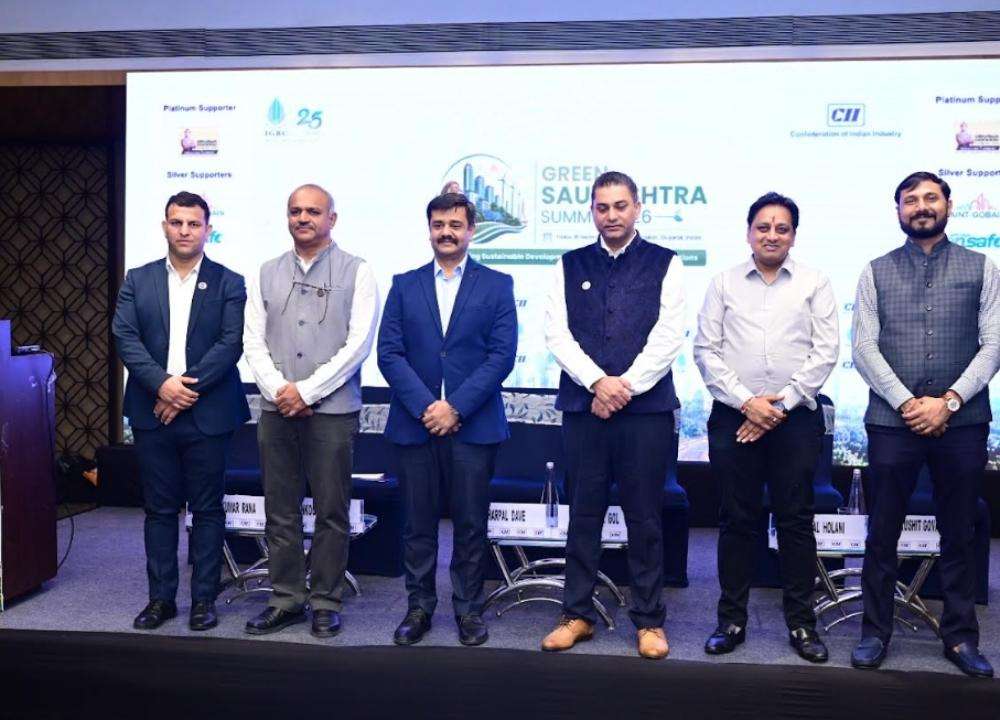
The CII–Indian Green Building Council (CII–IGBC) organised the Green Saurashtra Summit 2026 under the theme “Advancing Sustainable Development through Practical Green Solutions”, bringing together government representatives, industry leaders, real estate developers and built-environment professionals to discuss pathways for sustainable and future-ready growth across the Saurashtra region.
The Summit highlighted the growing adoption of green building practices in the region, with 102 IGBC-rated projects covering approximately 0.35 billion sq ft of built-up area. Residential and commercial developments constitute the principal categories, reflecting the increasing integration of sustainability into Saurashtra’s expanding built environment.
The Summit examined opportunities to advance sustainable planning, resource efficiency, low-carbon construction, energy-conscious design and innovative green technologies. Stakeholders from Rajkot, Morbi, Jamnagar, Bhavnagar, Junagadh, Porbandar and other parts of Saurashtra participated in discussions focused on strengthening the region’s approach to sustainable development.
The 102 IGBC-rated projects represent a significant milestone for Saurashtra’s built environment and demonstrate growing interest in buildings that incorporate sustainability across design, construction and operations. IGBC rating frameworks cover areas including water efficiency, energy conservation, sustainable materials, waste management and occupant wellbeing.
Rushit Govani, Youth Rajkot Builders Association President, said, “The real estate sector in Saurashtra had a significant role to play in shaping the region’s future. The growing adoption of IGBC frameworks demonstrated that sustainability was becoming an important consideration for the next generation of developers and homebuyers. The industry needed to move from awareness to wider implementation by making energy efficiency, water conservation, sustainable materials and healthier spaces part of mainstream development.”
Vishal Holani, Past Chairman, CII Gujarat Western Zone, said, “Sustainable growth and industrial competitiveness had become closely connected. For Saurashtra, the opportunity was to combine its strong entrepreneurial and industrial base with resource-efficient technologies and green infrastructure. Industry could accelerate this transition by investing in energy efficiency, renewable energy, sustainable materials and innovative solutions that delivered both environmental and economic value.”
Kunal Gol, Chairman, IGBC Rajkot Chapter and Director, Elixir Realty, said, “Saurashtra is at an important juncture in its growth journey, and the choices we make today will shape the region’s built environment for decades to come. With 102 IGBC-rated projects covering 0.35 billion sq ft, the region has already demonstrated a growing commitment to sustainable development. The next step is to scale this momentum by making green building practices, resource efficiency and climate-responsive design an integral part of mainstream development.”
The programme included sessions on “Advancing Sustainable Development in Saurashtra”, sustainable development in Rajkot, and “Sustainable Development in Saurashtra – From Vision to Action”. A special address by Mr. Chetan Nandani, Deputy Municipal Commissioner, Rajkot Municipal Corporation, was also featured.
A fireside chat on “Shaping a Sustainable Rajkot – Development, Infrastructure & the Built Environment” examined sustainable planning, climate-responsive development and resource efficiency. The concluding technical session focused on practical solutions for water, energy, resources and wellbeing, including building performance, Net Zero pathways, next-generation glass technology and low-carbon construction.
With 102 projects covering 0.35 billion sq ft, the Summit highlighted the potential to expand sustainable practices across residential, commercial, industrial and public infrastructure and called for continued collaboration among government, developers, architects, industry and citizens to drive measurable, region-wide action.