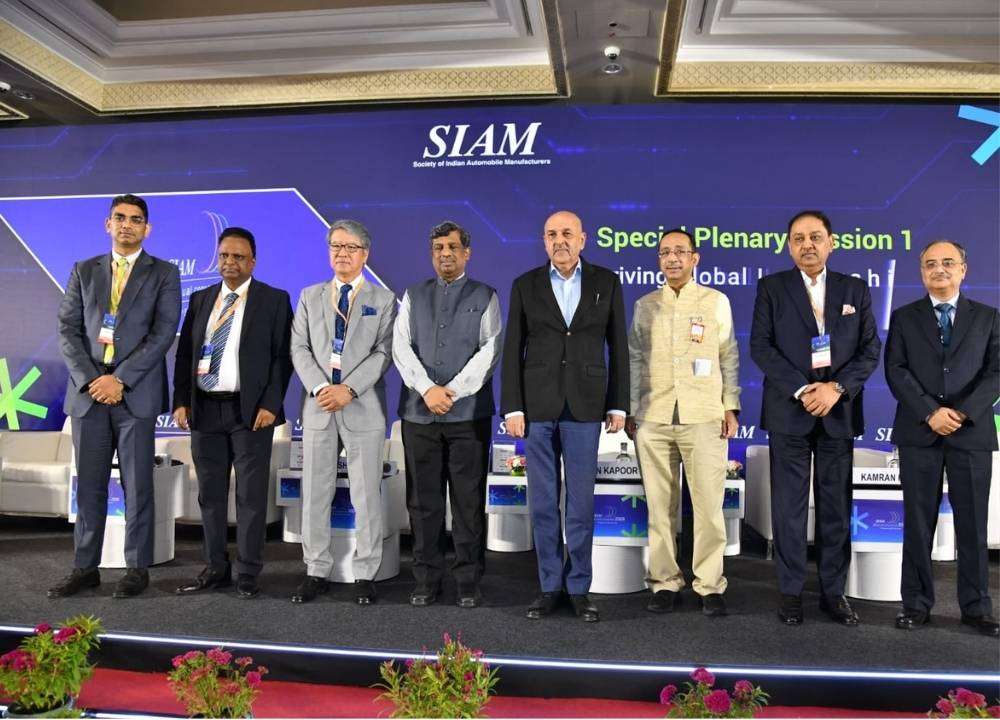
India’s automobile industry is working towards strengthening the country’s position as a global leader in sustainable mobility, with industry leaders and policymakers discussing the roadmap at the 66th Annual Convention of the Society of Indian Automobile Manufacturers (SIAM). The Special Plenary Session 1, titled “Driving Global Leadership in Sustainable Mobility,” focused on the steps needed to build a cleaner, affordable and globally competitive mobility sector by 2047.
Tarun Kapoor, Advisor to the Prime Minister of India, said the automobile industry has an important role in the country’s economic growth. He called for faster adoption of cleaner fuels, including electric mobility, biofuels and green hydrogen. “India’s mobility transition must accelerate towards cleaner fuels, with electric, biofuels and green hydrogen shaping the way forward,” Kapoor said. He also stressed the need to expand charging infrastructure, move heavy vehicles towards electric power, strengthen the export ecosystem and develop India as a global centre for advanced mobility technologies and manufacturing.
V Umashankar, Secretary, Ministry of Road Transport & Highways, said cooperation between the government and industry has supported the growth of the automobile sector. He said the government’s PARIVARTAN scheme for commercial vehicles in Delhi-NCR is gaining momentum and is expected to bring changes to the commercial vehicle segment in the region.
Kamran Rizvi, Secretary, Ministry of Heavy Industries, said government programmes such as FAME and the Production Linked Incentive (PLI) scheme have helped build scale in India’s electric mobility industry. He said electric vehicles are expected to gain a larger share of the market over the next 10 to 15 years. He also called for faster development of new technologies and greater focus on domestic innovation.
Hisashi Takeuchi, Managing Director and CEO of Maruti Suzuki India, highlighted the importance of keeping mobility affordable. He said GST reforms have helped make vehicle ownership more accessible to first-time buyers. Mr Takeuchi also pointed to India’s growing alternate fuel network. He said the wider availability of CNG and biofuels is helping reduce dependence on fossil fuels while supporting the country’s sustainability goals.
Ola Källenius, CEO of Mercedes-Benz and President of the European Automobile Manufacturers’ Association (ACEA), addressed the session virtually on the use of AI in sustainable mobility. He highlighted India’s growing role in research and development, local vehicle production and new mobility technologies. Mr Källenius said India and Europe could work together to shape the future of digital mobility.
The session also featured a presentation by McKinsey & Company on the use of AI to support sustainable mobility. Nitesh Gupta, Senior Partner, McKinsey & Company, delivered the presentation. Shenu Agarwal, Vice President, SIAM and Managing Director and CEO of Ashok Leyland, and R Velusamy, Chairman, SIAM Passenger Vehicle CEOs Council and President – Automotive Business, Mahindra & Mahindra, also participated in the discussions.
The Society of Indian Automobile Manufacturers (SIAM) is the apex national body representing major vehicle and engine manufacturers in India. Registered under the Societies Registration Act, 1860, SIAM operates with charitable objectives focused on supporting the growth and development of the Indian automobile industry.
SIAM works to increase the automobile industry’s contribution to the Indian economy while encouraging greater efficiency and responsible business practices across the sector. It also supports the industry in meeting its social responsibilities and promoting sustainable development.
A key focus of SIAM is improving the environmental performance of the automobile sector. The organisation works on initiatives aimed at reducing the industry’s environmental impact and promoting cleaner and more sustainable mobility. It also places strong emphasis on road safety and the protection of vehicle users and the public. In recognition of its objectives and activities, SIAM has been granted registration under the Income Tax Act, 1961 as an institution established for charitable purposes