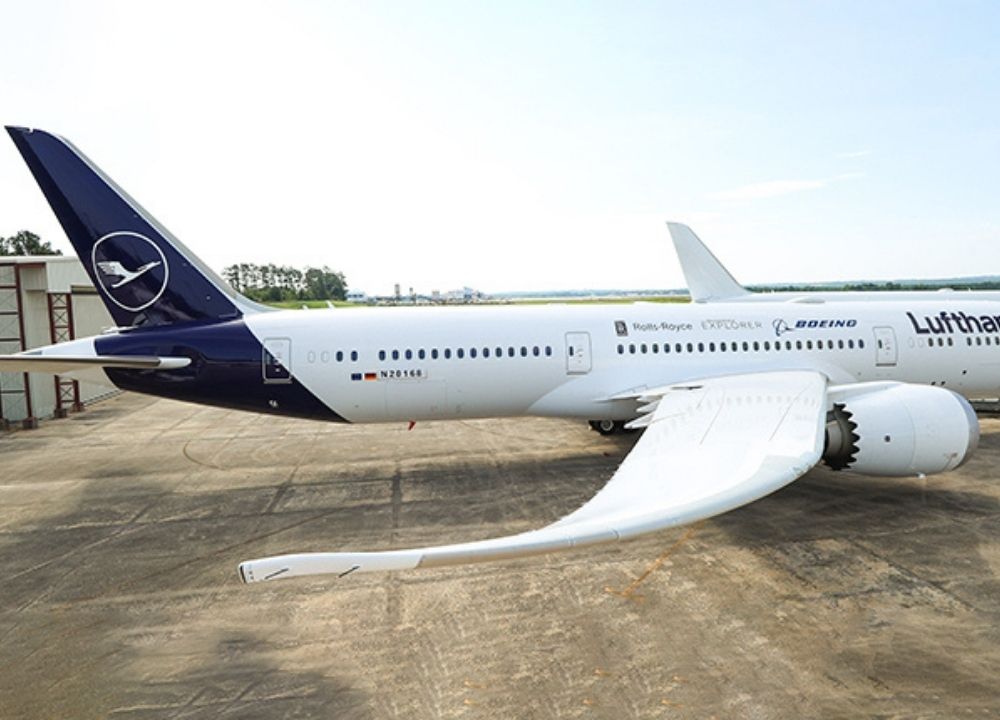
Rolls-Royce has partnered with Boeing and Lufthansa Group to test advanced aviation technologies designed to improve fuel efficiency and reduce aircraft noise. The flight trials form part of Boeing’s 2026 ecoDemonstrator Explorer programme and aim to accelerate the development of more sustainable commercial aviation solutions.
The testing will begin later this month at Boeing’s facility in Glasgow, Montana, using a Boeing 787-9 Dreamliner powered by Rolls-Royce Trent 1000 engines. The aircraft, which will eventually be delivered to Lufthansa, will undergo a series of flight evaluations through mid-August to validate new technologies under real operating conditions.
A key focus of the programme is the evaluation of Rolls-Royce’s Next Generation Inlet, an advanced engine inlet demonstrator featuring a shorter design and enhanced acoustic treatments. The new inlet is designed to support the integration of future fuel-efficient engines while reducing aircraft weight and aerodynamic drag without compromising noise performance.
The programme will also assess Intelligent Operations flight paths that use advanced algorithms and multiple data sources to optimise aircraft departure and arrival procedures. These digitally generated flight profiles are expected to improve fuel efficiency while reducing aircraft noise around airports, benefiting both airlines and surrounding communities.
Commenting on the initiative, Lane Ballard, Chief Technology Officer at Boeing, said the company continues to invest in technologies that improve aircraft performance and operational efficiency. He noted that the innovations being tested have the potential to deliver significant value to airline customers and industry partners by enhancing fuel economy and lowering noise emissions.
Grazia Vittadini, Chief Technology Officer of Lufthansa Group, said the long-standing partnership between Lufthansa and Boeing continues to support the advancement of sustainable aviation. She added that testing these technologies alongside Rolls-Royce will help validate solutions capable of improving efficiency and reducing environmental impact under real-world operating conditions.
Alan Newby, Director of Research and Technology at Rolls-Royce, said the programme represents the culmination of more than a decade of collaboration between Rolls-Royce and Boeing. He noted that the flight trials will provide valuable operational data on technologies designed to improve engine efficiency, reduce noise and support more sustainable air travel. According to him, testing innovations in commercial service conditions is essential for delivering practical benefits to airline customers and the broader aviation industry.
The project forms part of Phase III of the US Federal Aviation Administration’s Continuous Lower Energy, Emissions and Noise (CLEEN) programme, which supports the development and demonstration of technologies that improve aircraft fuel efficiency while reducing emissions and community noise. Since its launch in 2012, Boeing’s ecoDemonstrator programme has evaluated more than 260 technologies focused on enhancing safety, improving operational efficiency and reducing fuel consumption, emissions and noise.
The initiative also builds on Rolls-Royce’s ongoing development of the Trent 1000 engine family, which powers the Boeing 787 Dreamliner. Since entering service in 2011, the engine has undergone continuous improvements in fuel efficiency, durability and operational performance. The latest Trent 1000 XE standard is now the production engine for future Boeing 787 deliveries, with existing customers also being upgraded to the new configuration.
Through this collaboration, Rolls-Royce, Boeing and Lufthansa aim to accelerate the adoption of advanced aviation technologies that support cleaner, quieter and more efficient air transport while contributing to the industry’s long-term sustainability goals. Rolls-Royce is a global engineering and technology company that develops advanced power and propulsion solutions for the aerospace, defence, marine and energy sectors. Its products and services help customers meet growing power needs, support defence capabilities and enable reliable transportation and industrial operations worldwide.
The company operates in 47 countries and serves customers in more than 100 markets, including airlines, aircraft leasing companies, armed forces, navies, marine operators and industrial businesses. Rolls-Royce continues to strengthen its business through a long-term transformation programme focused on improving competitiveness, driving innovation and supporting customers in the global energy transition.
In 2025, Rolls-Royce reported underlying revenue of £20.1 billion and an underlying operating profit of £3.46 billion. Rolls-Royce Holdings plc is listed on the London Stock Exchange (LSE: RR) and its American Depositary Receipts trade under the ticker RYCEY.
Headquartered in Friedrichshafen, Germany, Rolls-Royce Power Systems employs around 11,000 people and offers a broad portfolio of power generation and propulsion solutions. Its mtu-branded engines and systems are used in ships, rail, heavy-duty land vehicles, defence applications, and the oil and gas sector.
The company also provides diesel and gas-powered systems, battery energy storage solutions, combined heat and power systems, and microgrids for mission-critical, standby and continuous power applications. Through its growing range of low-emission and sustainable technologies, Rolls-Royce Power Systems is supporting the global shift towards cleaner and more efficient energy solutions.