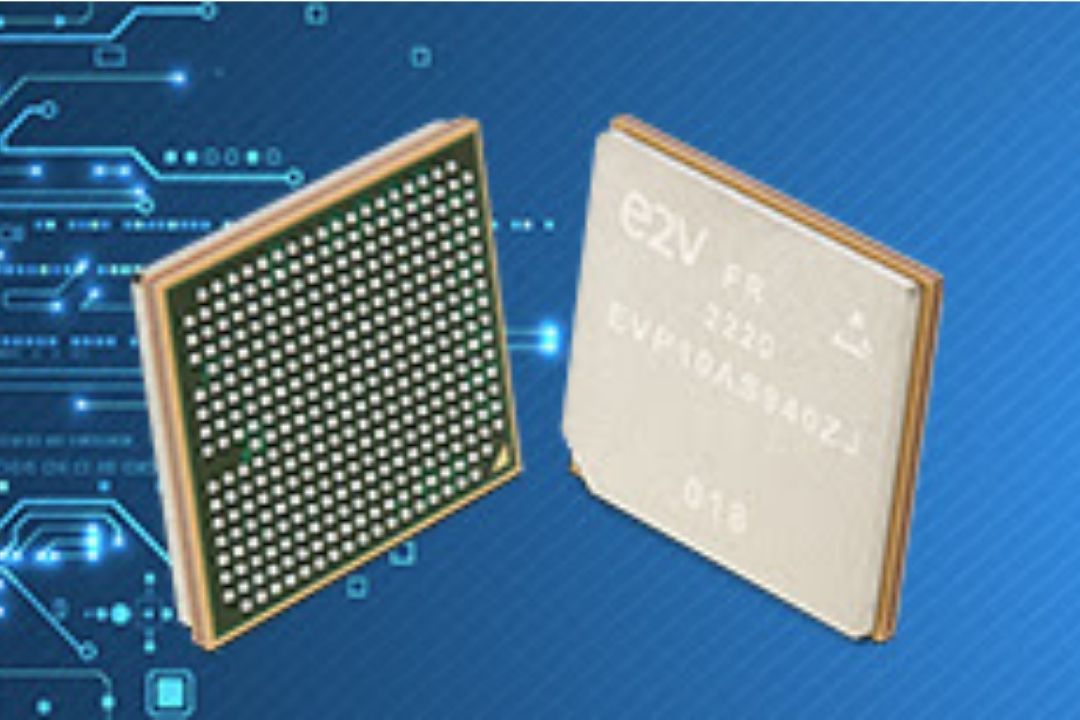
Teledyne e2v Semiconductors has announced successful radiation test results for its EV10AS940, a 10-bit, 12.8 GSps analog-to-digital converter (ADC) designed for high-performance space payloads and other mission-critical applications. The latest findings validate the device’s ability to operate reliably in harsh radiation environments, providing system designers with greater confidence for deployment in advanced satellite communications, synthetic aperture radar (SAR), electronic intelligence and scientific space missions.
The radiation evaluation forms part of an extensive Single Event Effects (SEE) qualification programme carried out at internationally recognised test facilities, including RADEF in Finland and the Texas A&M University Cyclotron Institute in the United States. During the campaign, multiple EV10AS940 devices were subjected to heavy-ion irradiation across a wide range of operating conditions, including Linear Energy Transfer (LET) levels of up to 94 MeV•cm²/mg.
The testing confirmed that the EV10AS940 experienced no Single Event Latch-up (SEL) under any of the evaluated conditions, including maximum LET exposure, elevated operating temperatures and increased supply voltage. Following completion of the qualification programme, all tested devices remained fully functional with no evidence of performance degradation, highlighting the converter’s resilience for long-duration space missions.
Commenting on the results, Victoria Nasserddine, Product Marketing Manager, Teledyne e2v Semiconductors, said, “Space systems demand components that consistently deliver high-speed performance while maintaining operational integrity in challenging radiation environments. The successful completion of these tests demonstrates the robustness of the EV10AS940 and provides designers with additional assurance when developing advanced payloads where reliability and signal accuracy are essential.”
The EV10AS940 has been developed to support high-bandwidth applications requiring rapid and accurate data conversion under extreme operating conditions. Its capabilities make it well suited for next-generation satellite communications, radar systems, electronic intelligence platforms and advanced scientific instrumentation, where dependable performance is critical throughout the mission lifecycle.
In addition to the SEE campaign, Total Ionizing Dose (TID) characterisation has also been completed, further confirming the device’s capability for sustained operation in radiation-intensive environments. Teledyne e2v stated that additional qualification activities are underway, with comprehensive radiation reports expected to be released by the end of 2026.
The latest qualification milestone reinforces Teledyne e2v’s continued focus on delivering high-reliability semiconductor technologies for the global space and defence sectors. By combining advanced data conversion performance with demonstrated radiation resilience, the EV10AS940 is positioned to support the growing demand for robust electronic components in increasingly sophisticated space missions.
Teledyne e2v develops advanced semiconductor technologies for the healthcare, life sciences, transportation, industrial, defence and space sectors. Its portfolio includes high-reliability data converters, radiation-tolerant memories, microprocessors and specialised manufacturing and testing services. As part of the Teledyne Imaging Group and Teledyne Technologies Incorporated (NYSE: TDY), the company works with customers worldwide to develop technologies that enhance system performance in demanding operating environments.