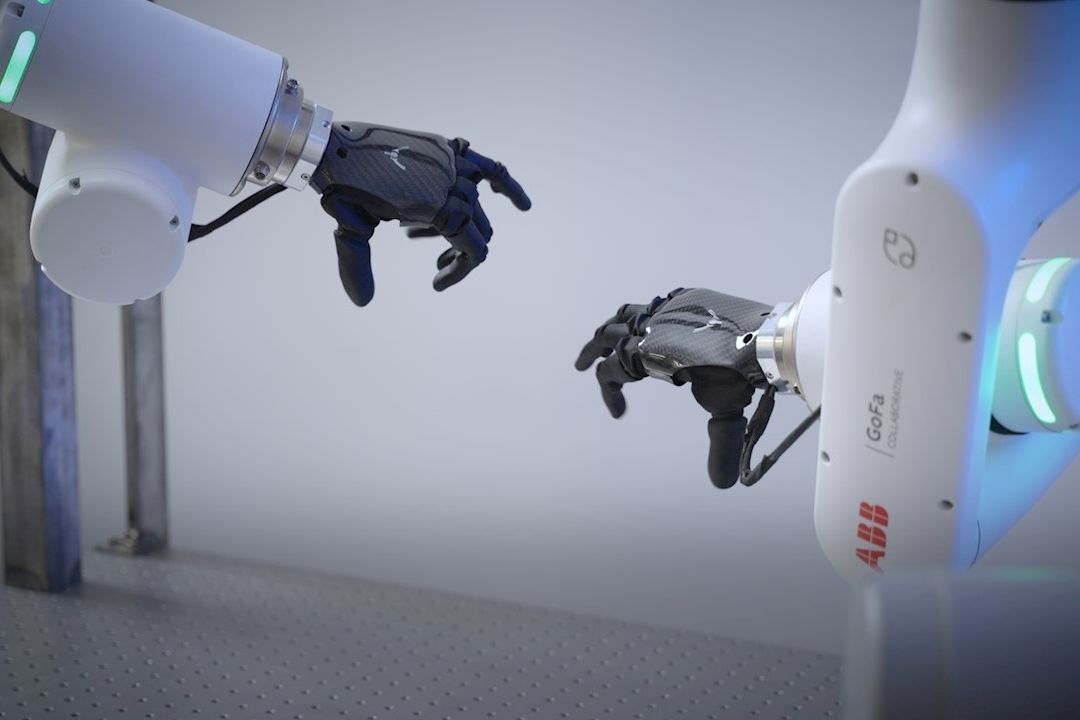
ABB Robotics has joined forces with California-based bionics innovator PSYONIC to develop a new generation of intelligent robotic systems capable of handling delicate and complex tasks with greater precision. The collaboration combines ABB’s industrial robotics expertise with PSYONIC’s advanced prosthetic technology to explore how real-world human movement and touch data can train robots to perform highly skilled manipulation tasks that have traditionally challenged industrial automation.
At the centre of the initiative is the integration of ABB’s GoFa™ collaborative robot with the PSYONIC Ability Hand, an advanced prosthetic hand equipped with touch sensing, pressure detection and compliant mechanics. Originally designed for human users, the technology generates valuable data on grip force, object interaction and movement patterns. ABB and PSYONIC will use this information to improve robotic learning, enabling machines to better understand how humans naturally grasp, move and manipulate objects.
The collaboration supports ABB Robotics’ long-term vision of Autonomous Versatile Robotics (AVR), where robots can perceive their surroundings, make informed decisions and execute tasks with human-like precision in constantly changing environments. The companies believe this approach will accelerate the development of physical AI by allowing robots to learn from real-world interactions rather than relying solely on programmed instructions.
Marc Segura, President of ABB Robotics, said human dexterity remains one of the greatest challenges in robotics despite decades of technological progress. He noted that combining advanced robotics with data generated through prosthetic use will help bridge the gap between human capability and machine performance, creating opportunities for automation across industries that require delicate handling and adaptive decision-making.
PSYONIC Founder and CEO Dr Aadeel Akhtar said robotic dexterity is driven as much by high-quality data as it is by hardware innovation. By using the same prosthetic hand on both people and robots, the company can capture detailed information about movement, contact and grip behaviour, creating a valuable dataset that improves robotic learning and real-world performance.
ABB’s GoFa collaborative robot provides the accuracy and repeatability needed to translate human-generated data into reliable industrial applications. Its ability to consistently reproduce subtle variations in finger movement, grip strength and positioning makes it an ideal platform for developing advanced robotic manipulation capabilities.
The partnership will initially focus on applications where conventional robotic grippers often struggle, including handling fragile, irregularly shaped or highly variable objects. Industries expected to benefit include automotive manufacturing, aerospace, logistics, packaging, healthcare and industrial automation. More capable robotic handling systems can improve production efficiency, reduce repetitive manual work and enhance workplace safety while allowing employees to focus on higher-value tasks.
Industry research continues to highlight the growing importance of advanced gripping technologies in modern manufacturing. According to the International Federation of Robotics, intelligent gripping systems combined with digital integration can reduce engineering time by up to 30 percent, improving deployment speed and delivering stronger returns on automation investments.
The initiative also reflects ABB Robotics’ strategy of collaborating with technology partners to accelerate innovation in industrial automation. By combining artificial intelligence, robotics and real-world human interaction data, the partnership aims to develop robotic systems that are more adaptable, responsive and capable of operating reliably in complex production environments. ABB Robotics is one of the world’s leading robotics companies, offering a comprehensive portfolio of industrial robots, collaborative robots and autonomous mobile robots supported by AI-enabled software solutions. PSYONIC, headquartered in San Diego, develops advanced bionic technologies that combine speed, strength, durability and sensory feedback while driving innovation at the intersection of robotics, artificial intelligence and brain-computer interfaces