

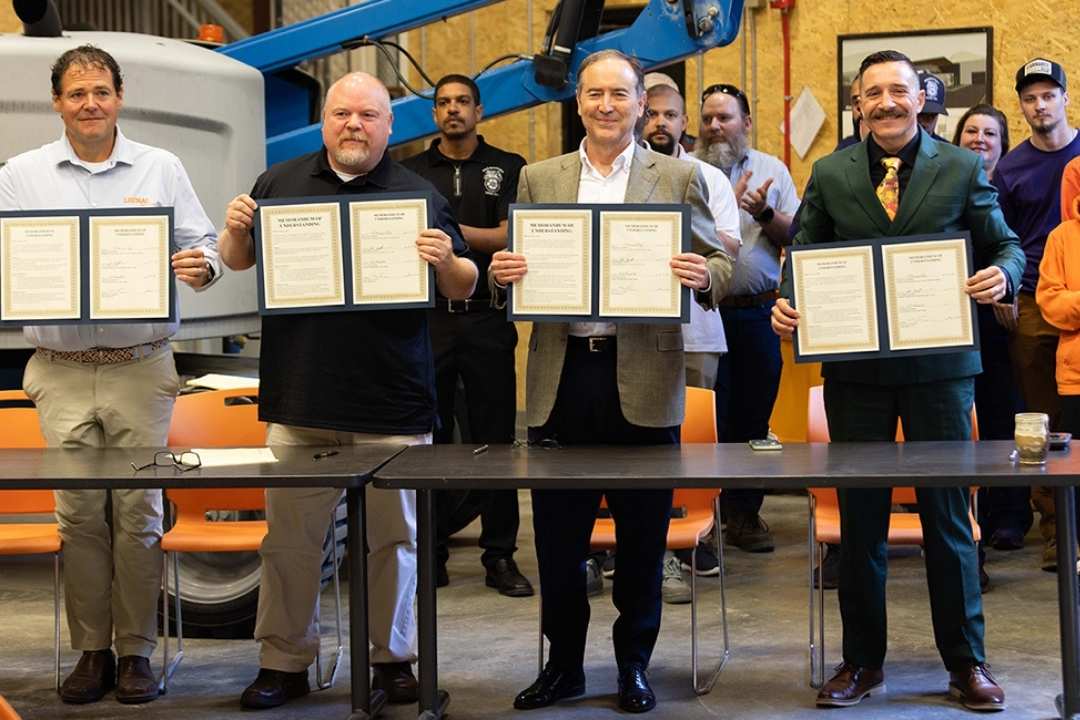
Alaska’s leading construction labor organizations and 8 Star Alaska LLC, a subsidiary of Glenfarne Alaska LNG LLC, have signed a Memorandum of Understanding (MoU) aimed at prioritizing local employment for the Alaska LNG project, one of the largest energy infrastructure developments planned in the state’s history. The agreement establishes a framework for future Project Labor Agreements covering major phases of construction and related activities while ensuring that qualified Alaska workers remain the preferred source of labour throughout the project’s execution.
Representatives from the Building and Construction Trades Council of Southcentral Alaska, the Fairbanks Building and Construction Trades Council, the Alaska Petroleum Joint Crafts Council and 8 Star Alaska formalized the agreement during a ceremony at the Alaska Laborers Training School in Chugiak. The Alaska LNG project is expected to generate approximately 12,000 construction jobs during the development phase and around 1,000 permanent operational positions after commissioning. In addition to supporting domestic energy supply, the project aims to position Alaska as a significant exporter of liquefied natural gas while generating long-term economic benefits for the state.
The Memorandum of Understanding outlines cooperation between labor organizations and project developers to ensure workforce availability, labour stability and efficient project execution. The planned agreements will cover major facilities including LNG export terminals, gas treatment plants, compressor stations, construction camps, logistics operations and associated infrastructure.
Pipeline construction activities will be governed through a separate labour agreement currently being developed with pipeline construction unions.
Bronson Frye, President of the Building and Construction Trades Council of Southcentral Alaska, said the project offers a historic opportunity to create thousands of well-paying jobs for Alaska residents while drawing upon the experience of union workers accustomed to executing complex projects in demanding environments.
Lake Williams, President of the Fairbanks Building and Construction Trades Council, noted that Project Labor Agreements have consistently helped deliver large infrastructure projects on schedule through workforce planning, standardized employment practices and access to skilled labour.
Joey Merrick, President of the Alaska Petroleum Joint Crafts Council, described Alaska LNG as a once-in-a-generation infrastructure project that will create lasting opportunities for future generations of skilled workers. Rex Canon, Co-President of 8 Star Alaska, reaffirmed the company’s commitment to placing Alaska workers at the centre of project development and ensuring local communities benefit directly from the significant employment and economic opportunities the project will create.
The agreement covers 18 affiliated construction unions representing a broad range of skilled trades. Together, the organizations aim to support timely execution of the project while strengthening Alaska’s workforce and reinforcing the state’s role in the global energy sector. The Alaska AFL-CIO represents more than 50,000 workers across the state through its network of affiliated unions. Its membership spans a broad range of industries and professions, including construction trades, education, transportation, healthcare, public services, and local, state, and federal government employment.
For decades, organized labor has played a pivotal role in Alaska’s economic and social development, helping build the infrastructure, industries, and communities that have shaped the state. Since before Alaska achieved statehood, union workers have delivered skilled craftsmanship, technical expertise, and workforce excellence on some of the largest and most complex projects undertaken in the state.
Alaska continues to maintain one of the highest rates of union membership in the United States, reflecting a longstanding commitment to quality workmanship, workplace safety, and professional standards. Through training programs, apprenticeships, and workforce development initiatives, the Alaska AFL-CIO remains dedicated to preparing the next generation of skilled workers while supporting sustainable economic growth and prosperity across the state.
The Alaska LNG project is a major energy infrastructure initiative designed to transport natural gas from Alaska’s North Slope to consumers within the state while also enabling large-scale exports of liquefied natural gas (LNG) to international markets.
The project includes an approximately 807-mile, 42-inch natural gas pipeline that will connect North Slope gas resources to communities and energy users across Alaska. Once fully developed, Alaska LNG is expected to produce up to 20 million tonnes per annum (MTPA) of LNG for export.
To accelerate implementation, the project is being developed in two financially independent phases. The first phase focuses on constructing the domestic pipeline system to provide reliable and affordable natural gas to Alaskan residents and businesses. The second phase will add LNG export infrastructure, positioning Alaska as a significant participant in the global LNG market. Glenfarne holds a 75 percent ownership stake in Alaska LNG, while the remaining 25 percent is owned by the State of Alaska through the Alaska Gasline Development Corporation.
Glenfarne Group is a privately owned global developer, owner, and operator of energy infrastructure assets. Through its subsidiaries, the company manages a diversified portfolio of approximately 60 energy assets across three primary business segments: Global LNG Solutions, Grid Stability, and Renewable Energy.
Glenfarne’s North American LNG development portfolio comprises 32.8 million tonnes per annum of permitted LNG capacity across projects located in Alaska, Louisiana, and Texas. The company focuses on delivering critical energy infrastructure that supports energy security, economic growth, and the transition to a more resilient global energy system.









