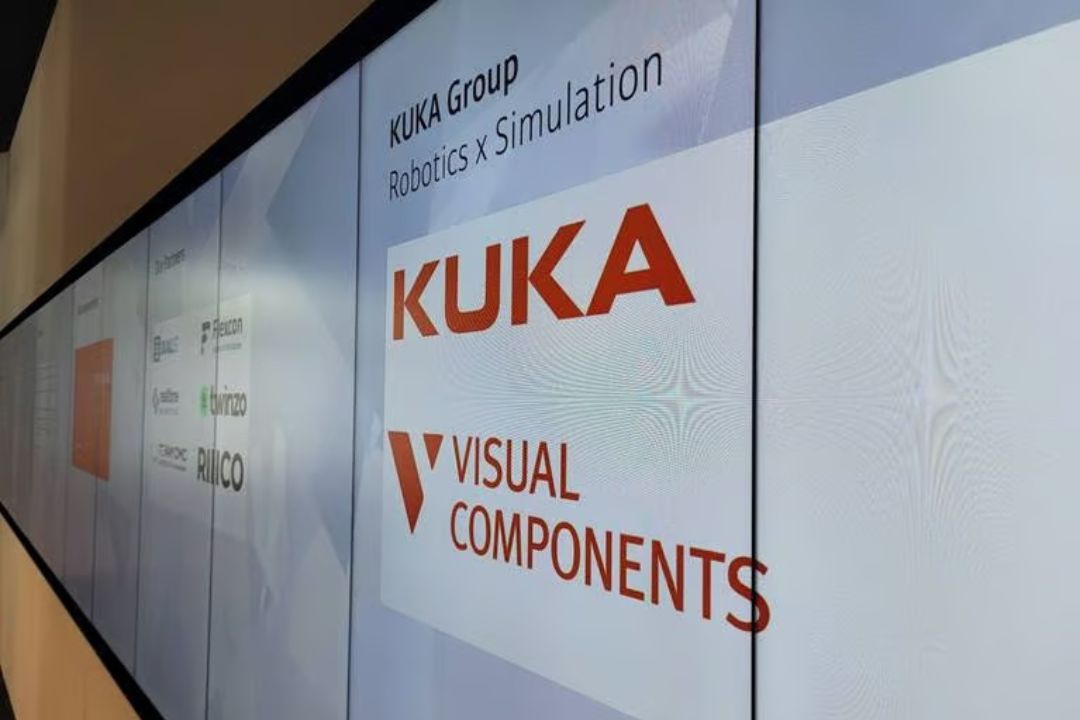
KUKA Group and Visual Components are strengthening their focus on simulation-driven automation as manufacturers increasingly adopt digital twins, virtual commissioning, and intelligent production planning technologies to improve efficiency, flexibility, and operational performance. Simulation technologies are becoming a central element of modern industrial automation strategies as companies seek to reduce deployment risks, accelerate production readiness, and improve lifecycle management across manufacturing operations.
According to industry estimates, the global digital twin market is expected to witness significant long-term growth, driven by rising demand for virtual manufacturing, predictive operations, and intelligent automation systems. Visual Components, which has been part of the KUKA Group since 2017, is playing a key role in advancing these capabilities through manufacturing simulation platforms that support collaborative planning, virtual production modelling, and high-fidelity digital twin development.
Christoph Schell, CEO of KUKA Group, said simulation has evolved into a strategic capability that extends far beyond traditional engineering functions. “Manufacturers today require tools that enable faster decision-making, lower operational risk, and greater flexibility across the automation lifecycle. Through our collaboration with Visual Components, we are helping customers accelerate deployment timelines and improve efficiency through simulation-driven automation,” he said.
The companies recently hosted a Simulation Event at KUKA’s headquarters in Augsburg, Germany, bringing together customers, technology providers, and system integrators to demonstrate how virtual simulation technologies are reshaping industrial automation workflows. The event featured participation from several ecosystem partners including TWINZO, DUALIS, RIIICO, REALTIME ROBOTICS, Flexcon, and Team CMC.
Visual Components also introduced Version 5.0 of its manufacturing simulation platform earlier this year, further enhancing support for digital twins, collaborative engineering, and virtual commissioning processes. The software enables manufacturers to simulate production layouts, robot movements, and automation workflows before physical systems are deployed.
Mikko Urho, CEO of Visual Components, said simulation technologies allow manufacturers to identify bottlenecks, optimise cycle times, and reduce costly modifications during installation and production ramp-up stages. “The ability to test and validate automation concepts in a virtual environment significantly improves collaboration between engineering, operations, and management teams while supporting more informed investment decisions,” he said.
KUKA stated that simulation technologies form a key part of its broader Automation 2.0 strategy, which focuses on intelligent, connected, and software-driven production systems. The approach is designed to support manufacturers facing increasing demands for customization, operational resilience, and faster innovation cycles.
By combining industrial automation expertise with advanced simulation technologies, KUKA Group and Visual Components aim to help manufacturers build more agile and scalable production systems capable of adapting to rapidly changing industrial requirements. KUKA Group is a global automation company providing intelligent robotics, automation systems, software, and digital manufacturing solutions for industrial applications worldwide.