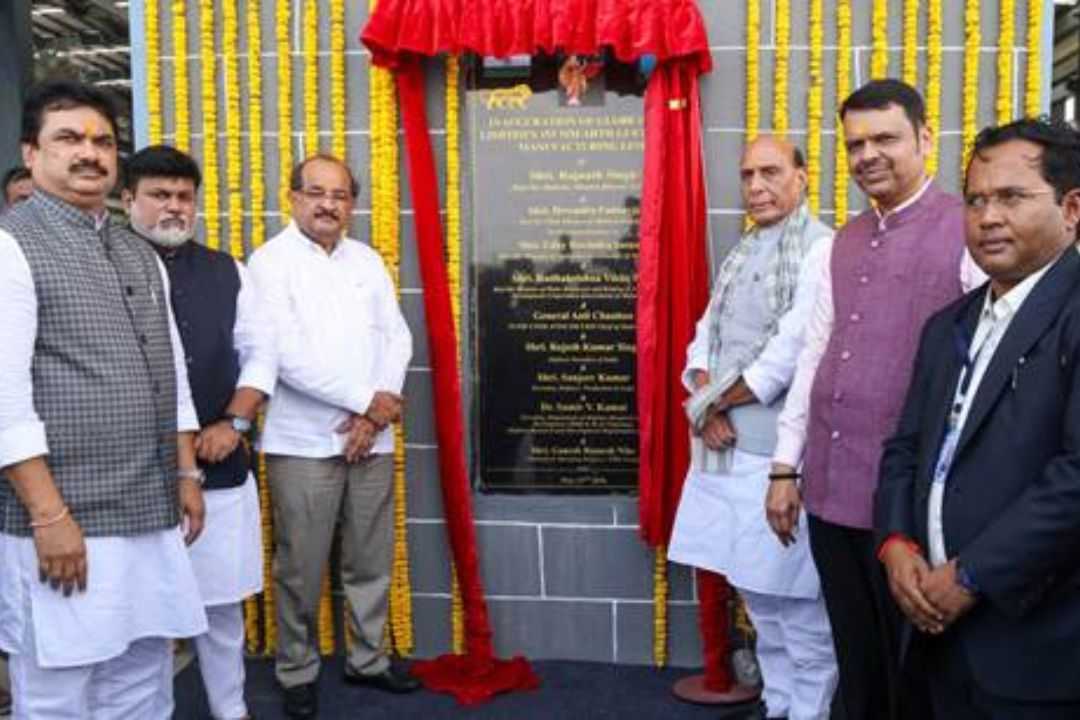
Defence manufacturing is central to India’s strategic and economic future, Raksha Mantri Rajnath Singh said while inaugurating the new defence manufacturing complex of NIBE Group in Shirdi. Calling self-reliance in military technology a national imperative, he stated that countries capable of producing their own weapons systems shape their own destiny and strengthen their sovereignty.
The newly launched facility will focus on advanced artillery systems, missile and space technologies, rocket systems, energetic materials, and autonomous defence platforms. During the event, the Raksha Mantri flagged off India’s first 300-km Universal Rocket Launching System, ‘Suryastra’, and laid the foundation stone for a dedicated missile complex linked to the programme.
The ceremony also witnessed the unveiling of indigenous TNT and RDX plant technologies along with a renewable bio-energy compressed biogas plant. An MoU between NIBE Group and Black Sky for satellite assembly cooperation was also exchanged in the presence of senior government and industry representatives.
Addressing the gathering, Shri Singh said modern warfare is increasingly being driven by precision munitions, automation, and advanced technologies rather than the size of armed forces alone. Referring to recent global conflicts and India’s own Operation Sindoor, he noted that future combat preparedness would depend heavily on technological superiority and indigenous capabilities.
He highlighted the transformation of India’s defence ecosystem under the leadership of Prime Minister Narendra Modi, pointing out that defence production was once dominated by public sector units and ordnance factories. Over the last decade, policy reforms have enabled private industry to become a significant contributor to the sector.
The Raksha Mantri said the government’s initiatives, including liberalised FDI norms, the Strategic Partnership Model, Positive Indigenisation Lists, iDEX, ADITI, and the Technology Development Fund, have encouraged innovation and accelerated domestic manufacturing. He added that private industry now contributes nearly 25–30 per cent to India’s defence production, with the government aiming to raise the share to 50 per cent in the coming years.
He further stressed that national security and economic growth are deeply interconnected, particularly at a time when supply chains, trade networks, and critical minerals are increasingly being used as strategic tools globally. According to him, reducing dependence on imports in defence manufacturing is essential not only for wartime readiness but also for economic resilience and long-term development.
Maharashtra Chief Minister Devendra Fadnavis praised the Centre’s efforts to strengthen indigenous defence capabilities and said the collaboration between public and private sectors is creating a stronger and more modern defence ecosystem for the country. The event included defence technology demonstrations, MSME capability showcases, and interactions with industry leaders and defence stakeholders. Senior civil, military, and industry officials, including Chief of Defence Staff General Anil Chauhan and DRDO Chairman Dr Samir V Kamat, attended the programme.