India’s manufacturing and mobility sectors are moving towards electrification at a fast pace. Energy storage has become more important than ever before. Batteries are no longer just parts of a larger system. They now directly affect efficiency, cost, reliability, and long-term sustainability. However, lithium-based technologies dominate the global market today. This creates challenges related to supply concentration and pricing volatility. As a result, alternative chemistries are gaining interest as they can deliver reliable performance without these concerns. Gegadyne Energy is developing lithium-free energy storage solutions that are made in India for industrial and commercial applications.
The Idea That Started It All
Gegadyne Energy was formally registered in Mumbai in 2017, following foundational research that began between 2014 and 2015. The company was co-founded by Jubin Varghese, who serves as CEO, and Ameya Gadiwan, who is the CTO. Jubin began working on battery research during his second year of studying mechatronics engineering. From the beginning, the founders saw that an electric vehicle is essentially a battery on wheels and without solving the battery, the entire electric ecosystem cannot succeed. This reasoning led to the conclusion that the battery itself was where the core work needed to be done..
Building with lithium was not a viable path. China manufactures over 80% of the world’s lithium-ion battery supply, dominating the entire chain with players such as CATL and BYD. The founders chose instead to modify raw materials within established battery principles, an approach that makes adoption straightforward for industrial customers. The company operates from Andheri, Mumbai, and is the only company in India to have commercialised its patent portfolio through launched products.
Inside the Multi-Ion Innovation
The outcome of this research is the company’s proprietary chemistry, trademarked as Multi-Ion, which combines sodium and potassium on the cathode with unstructured carbon on the anode. Developed entirely by Indian researchers, this formulation removes dependence on lithium supply chains and is not produced by any other company globally. The technology is protected through granted patents and trademarks in India and the United States, with further international filings in progress.
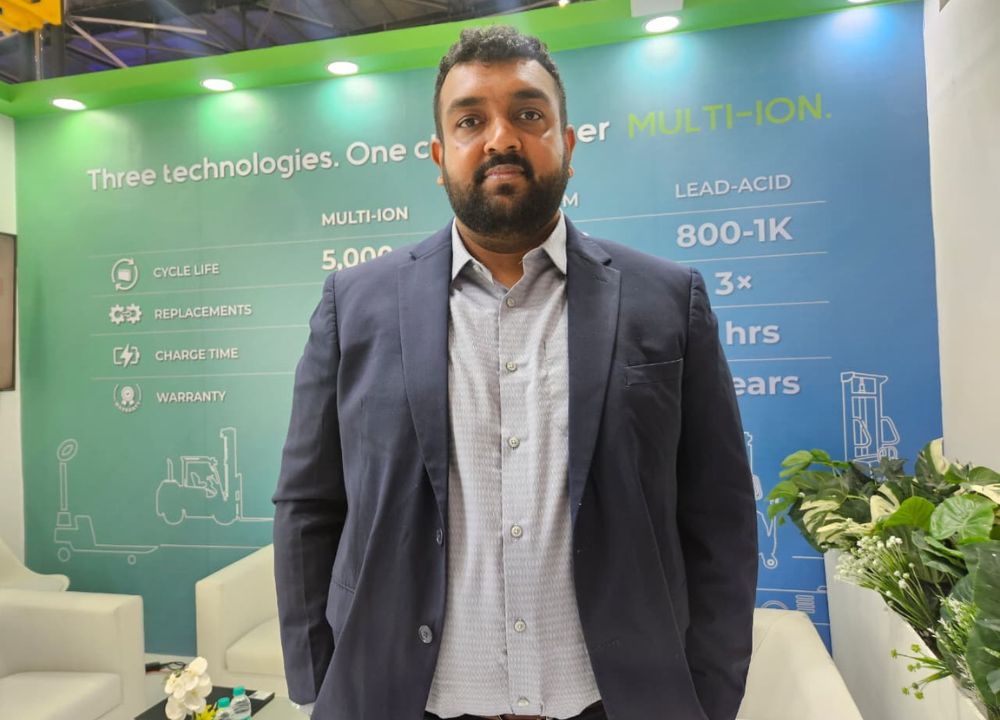
Building on this chemistry, the Multi-Ion system is engineered for industrial applications where consistent performance and reliability are essential. It offers over 5,000 charge cycles and is backed by a seven-year warranty. Depending on operational requirements, the batteries can be fully charged in under 15 minutes. Compared to lithium-based alternatives, the system delivers stronger cycle life and efficiency, offering industrial operators a longer operational lifespan and a measurable return on investment from the outset.
Taking the Technology to Industry
Moving from laboratory research to field deployment is a significant step in battery development, and Gegadyne Energy has pursued this through direct commercialisation. A recent milestone is the deployment of its battery systems with Godrej, where the products are now integrated into active commercial industrial operations. This real-world deployment has provided the company with field data that supports further market development.
Building on this foundation, the company is currently collaborating with multiple Indian and European OEMs, with additional product integrations planned for the coming quarters. Manufacturers who have reviewed the field data and the company’s existing customer base have found the technology to be a credible alternative to lithium for industrial use. Gegadyne Energy positions Multi-Ion as an additional option for industrial customers rather than a direct replacement for lithium across the broader market.
The Road Ahead for Clean Energy
India is at an early stage of electrification, and the adoption patterns visible in the EV two-wheeler segment are expected to extend to other sectors in the coming years. Industrial applications are likely to be among the first to transition, a shift accelerated by disruptions in conventional energy supply chains, including gas shortages that have highlighted the limitations of traditional power sources. Government initiatives supporting renewable energy combined with battery storage are reinforcing this direction as a stated alternative to coal-based power.
Gegadyne Energy’s development approach of modifying raw materials within established battery frameworks is well suited to this environment, as it reduces the adoption barrier for industrial customers and removes the need for new manufacturing infrastructure on their side. As the energy sector moves from centralised grid systems towards decentralised models, demand for reliable, alternative battery chemistries is expected to grow. The company’s lithium-free technology is positioned to support this transition across the industrial sector over the next five years.