

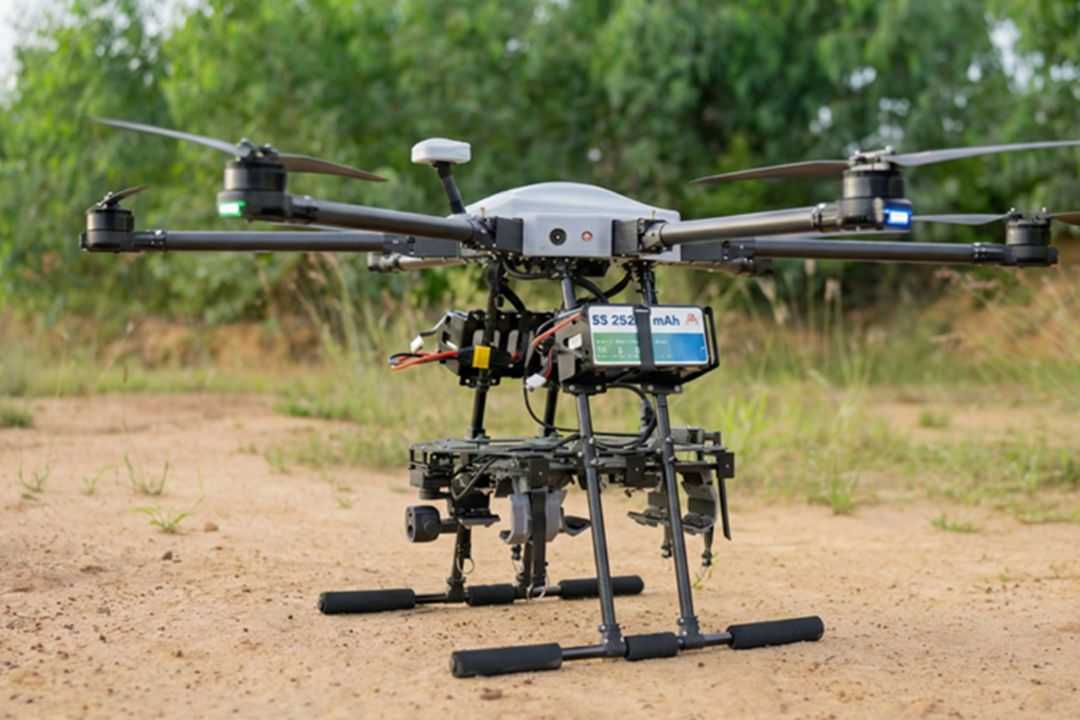
India’s defence manufacturing sector is undergoing a significant shift, with drone technologies emerging as a key driver of capability building and industrial growth. Supported by initiatives such as ‘Atmanirbhar Bharat’ and ‘Make in India,’ the country is steadily building a more self-reliant and innovation-led ecosystem. Notably, this progress is not just limited to operational readiness, but it is also strengthening domestic manufacturing across critical areas such as design, electronics, and system integration.
This momentum is reflected in recent industry data. According to the PIB Research Unit’s analysis, India’s defence production reached approximately ₹1.27 lakh crore in FY 2023-24, rising sharply from ₹46,429 crore in FY 2014-15. The growth trajectory has continued into FY 2024-25, with production estimated at around ₹1.51 lakh crore. Defence exports have also expanded significantly, reaching ₹23,622 crore, underscoring the increasing global acceptance of Indian-built systems. Within this broader growth story, drones are emerging as a high-impact segment, offering scalable, cost-effective, and adaptable solutions aligned with modern defence requirements.
From a manufacturing standpoint, the real shift is the move from assemblyled operations to deeper capability creation. India’s drone ecosystem is increasingly focusing on the localisation of critical subsystems. Domestic manufacturers are developing lightweight composite structures, propulsion systems, power management units, and modular payload integrations. This transition is enabling greater control over production timelines, improving supply chain resilience, and reducing dependence on imported components.
This push towards localisation is also driving the emergence of a more robust supplier ecosystem. Precision machining firms, electronics manufacturers, and embedded system developers are becoming integral to the UAV value chain, with Tier-2 and Tier-3 suppliers playing a critical role in enabling scalable production, improving cost competitiveness, and supporting rapid customisation. As a result, India is gradually moving towards a more distributed and defence-grade manufacturing model.
At the same time, the nature of drone technology itself is evolving, which is further shaping manufacturing priorities. Advancements in electronic warfare (EW)resilient and autonomous systems are redefining how UAVs are designed and built. Modern defence scenarios demand platforms that can operate in GPS-denied environments, withstand signal disruption, and execute missions with a high degree of autonomy. This is accelerating innovation in areas such as AI-enabled navigation, vision-based targeting, and intelligent mission control systems – requiring seamless integration of hardware, software, and communication technologies, and pushing manufacturers towards higher-value design and engineering capabilities.
This technological shift is closely linked to the growing role of the private sector, which is playing an increasingly important part in accelerating innovation and production. Emerging defence technology companies are adopting agile development approaches, enabling faster prototyping, iterative design, and modular platform development. This flexibility is particularly important in the drone segment, where operational requirements evolve rapidly. As a result, there is a clear industry-wide move towards building integrated capabilities, from aerostructure design and avionics integration to manufacturing and validation, allowing for a faster transition from concept to deployment-ready systems.
Collaboration across industry, startups, and supply chain partners is further strengthening this ecosystem. As capabilities mature, there is an increasing focus on interoperability, modular upgrades, and multi-mission adaptability, ensuring that UAV platforms remain relevant across a range of applications, from surveillance and reconnaissance to logistics and tactical support.
While the progress is encouraging, certain challenges remain. Dependence on imported components in advanced electronics and sensor technologies continues to be an area that requires focused investment. Strengthening domestic supply chains, expanding testing infrastructure, and building specialised talent will be critical to sustaining long-term growth.
Looking ahead, drone technologies present a unique opportunity to strengthen India’s defence manufacturing base in a meaningful and scalable way. They combine innovation, speed, and industrial depthqualities that are essential for building globally competitive capabilities. The next phase of growth will depend on how effectively the ecosystem can integrate design, development, and manufacturing into a cohesive and production-ready framework. It is safe to say, drones are not just transforming defence operations, they are also redefining how India builds and scales its manufacturing capabilities for the future.








