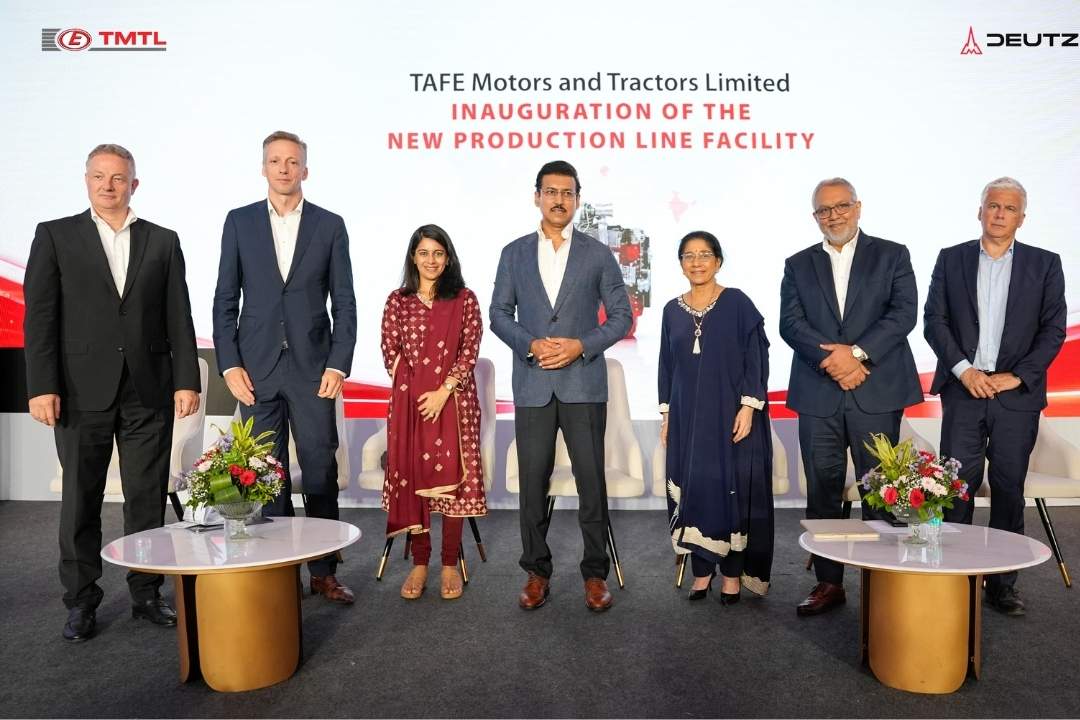
TAFE Motors and Tractors Limited (TMTL), a wholly owned subsidiary of Tractors and Farm Equipment Limited (TAFE), has inaugurated a new DEUTZ engine manufacturing facility at its existing plant in Alwar, Rajasthan. The facility marks the first manufacturing collaboration between TAFE Motors and Germany-based DEUTZ AG, bringing advanced engine technology and global manufacturing standards to India.
The facility was inaugurated by Colonel Rajyavardhan Singh Rathore, Minister for Industry & Commerce, Youth Affairs & Sports, IT & Communications, Sainik Welfare, and Skill Development & Entrepreneurship, Government of Rajasthan. The project represents a major step in strengthening India’s engine manufacturing capabilities while supporting domestic production and exports.
Under a licensing agreement with DEUTZ, TAFE Motors will manufacture 2.2-litre and 2.9-litre DEUTZ engines for Indian and international markets. The new facility has an annual production capacity of 35,000 engines and 50,000 sub-assemblies. Built with Industry 4.0 technologies, the plant features a fully integrated manufacturing execution system, digital connectivity across production operations, automated assembly processes and advanced quality monitoring.
Addressing the gathering, Rajyavardhan Singh Rathore said the investment reinforces Rajasthan’s position as an emerging manufacturing destination. He noted that the project reflects the vision of “Made in Rajasthan for the World” while supporting the national objective of building a self-reliant manufacturing ecosystem. He also appreciated TAFE’s long-term commitment to industrial development, innovation, skill creation and employment generation in the state.
Mallika Srinivasan, Chairman and Managing Director of TAFE, said the inauguration represents an important milestone in the company’s growth journey. She noted that TAFE and the Amalgamations Group together form one of India’s largest engine manufacturing ecosystems and expect to expand annual engine production capacity from 400,000 units to 550,000 units by 2030.
She added that the partnership combines DEUTZ’s engineering expertise with India’s manufacturing strengths to produce engines that meet international quality standards. The project is also expected to create opportunities for component suppliers and engineering industries across Rajasthan, further strengthening the state’s industrial base.
Dr Lakshmi Venu, Vice Chairman of TAFE, said the facility reflects the company’s continued investment in advanced manufacturing, operational excellence and globally benchmarked production systems. She highlighted that around 40 per cent of the workforce at the TAFE-DEUTZ facility comprises women, demonstrating the company’s focus on building a diverse and inclusive manufacturing workforce.
Sandeep Sinha, Chief Executive Officer of TAFE, said the plant integrates automation across manufacturing, testing and logistics operations. It also includes robotics, collaborative robots, vision-based inspection systems, a modern engine testing centre and an advanced quality laboratory with complete digital traceability to ensure consistent product quality for customers worldwide.
Dr Sebastian Schulte, Chief Executive Officer of DEUTZ AG, said the commissioning of the engine assembly line marks an important milestone in the collaboration between the two companies. He said the project reflects the commitment of both organisations to transform their shared vision into a successful industrial partnership.
Founded in Cologne, Germany, in 1864, DEUTZ is the world’s oldest engine manufacturer and has expanded its portfolio from conventional engines to advanced mobility and energy solutions. Its products serve construction, agriculture, material handling, power generation and defence applications across global markets.
The new Alwar facility further strengthens TAFE Motors’ position as a global engine manufacturer while expanding India’s role in advanced engineering and export-oriented manufacturing. The project is expected to contribute to technology development, local supply chain growth and employment while reinforcing the country’s manufacturing competitiveness in international markets.