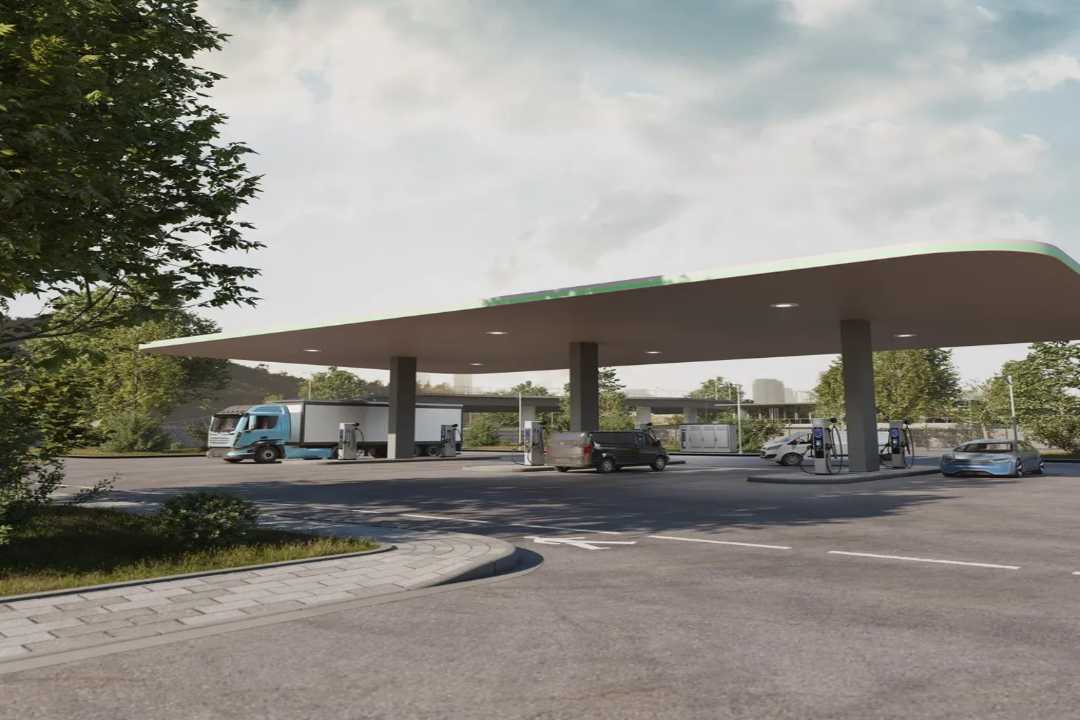
Siemens has unveiled SICHARGE FLEX, a new range of electric vehicle (EV) charging systems tailored to meet the evolving needs of fleet operators, transit hubs, and roadside charging stations. Built to be modular, scalable, and versatile, SICHARGE FLEX aims to support a wide range of use cases with a compact footprint and high-performance energy management.
As demand for EV infrastructure continues to grow rapidly, operators require flexible and future-proof charging solutions. SICHARGE FLEX answers this need by offering adaptable architecture capable of supporting various charging scenarios—from large fleet depots to highway charging corridors.
At the heart of the system is an advanced dynamic power distribution technology that adjusts in real time, routing energy where it’s most needed. All connections can be assigned power from any supply module, allowing the system to match changing charging demands as they occur. With a total system output ranging from 480 kW up to more than 1.68 MW, individual charge points can be configured in 80 or 120 kW steps. The system is compatible with both CCS and MCS standards, supporting up to four MCS charge points on a single platform and delivering up to 1,500 amps of charging current—ideal for high-demand applications like electric buses and heavy-duty trucks.
Despite its power, the design remains space-efficient. With a power density of up to 656 kW per square meter, the system can be installed in locations where space is limited. A front-in/front-out cooling setup allows placement against walls, and dispensers can be installed up to 300 meters away from the main cabinet. Mounting options include floor, wall, or overhead setups—allowing installations to be customized for any site layout.
“SICHARGE FLEX represents a major step in our efforts to create smart, adaptable charging ecosystems for today’s and tomorrow’s mobility needs,” said Markus Mildner, CEO of eMobility at Siemens Smart Infrastructure. “It’s built to give operators the flexibility to expand, adapt, and optimize charging performance while keeping operations efficient and reliable.”
The system integrates seamlessly with Siemens’ digital charging ecosystem. Operators can monitor and control infrastructure remotely using Sifinity Control, a cloud-based platform that offers configuration, real-time monitoring, and operational insights. The system’s user-focused design simplifies installation and supports long-term serviceability.
For fleet depots, the integration with DepotFinity provides intelligent energy load management, optimizing charging even with limited grid availability. This reduces the need for infrastructure upgrades and helps lower the overall cost of ownership.
Even ahead of its full commercial rollout, the system has already attracted significant industry interest. OMV, a Vienna-based provider of fuel and mobility services operating across Central Europe, has placed an initial order. The first installation will be in Kufstein, Austria, strategically located on the A12 corridor connecting Germany and Italy. This multi-use site—serving eTrucks, buses, and passenger vehicles—will start with six charging points, expanding to ten following grid reinforcement by the local DSO.
“Our goal is to offer cutting-edge charging infrastructure where it matters most,” said Eric Schulze, SVP of Retail Mobility & Convenience at OMV. “With SICHARGE FLEX, we can serve a broad spectrum of vehicles efficiently while planning for future growth.”
SICHARGE FLEX isn’t just about performance—it’s built with sustainability in mind. The system supports energy efficiency, helps balance loads on local grids, and contributes to broader decarbonization efforts. Cybersecurity is also a core feature, with data protection measures such as encrypted communications, secure boot protocols, and system integrity safeguards included as standard.
SICHARGE FLEX was officially presented at Busworld 2025 in Brussels, giving visitors a first look at the technology in action. Commercial availability is expected in 2026, with Siemens providing full support for deployment across fleet operators, logistics companies, charge point operators (CPOs), and OEMs.
Siemens eMobility offers a comprehensive portfolio for high-performance EV charging—including smart hardware, connected software, and full service support. The focus is on high-power DC fast charging for both depot and en-route applications. Customers include major fleet operators, energy providers, OEMs, and infrastructure developers committed to expanding sustainable mobility.
Siemens Smart Infrastructure (SI) is redefining the future of intelligent and adaptive infrastructure by seamlessly connecting energy systems, buildings, and industries. With a focus on addressing the global challenges of urbanization and climate change, SI delivers integrated, end-to-end solutions — from power generation to consumption — encompassing products, systems, software, and services from a single trusted source.
Through its digitalized ecosystem, Siemens Smart Infrastructure empowers customers to operate more efficiently, enabling communities to progress sustainably while contributing to the protection of the planet. Cybersecurity remains a cornerstone of this mission, ensuring safe, resilient, and reliable operations across all connected environments. Headquartered in Zug, Switzerland, Siemens Smart Infrastructure employs around 78,500 people worldwide as of September 30, 2024.
Siemens AG (Berlin and Munich) is a global technology leader focused on industry, infrastructure, mobility, and healthcare. Guided by its purpose “to create technology that transforms the everyday – for everyone,” Siemens combines the real and digital worlds to help customers accelerate their digital and sustainability transformations. Its innovations make factories smarter, cities more livable, and transportation systems cleaner and more efficient.
A pioneer in industrial AI, Siemens applies its deep industry expertise to make artificial intelligence — including generative AI — practical and impactful across diverse sectors. The company also holds a majority stake in Siemens Healthineers, a world-leading medical technology enterprise advancing healthcare innovation globally. In fiscal year 2024, ending September 30, Siemens Group reported revenue of €75.9 billion and net income of €9.0 billion, with approximately 312,000 employees worldwide across continuing operations.