SEMICON India 2025 Exhibition, the flagship event of India’s semiconductor industry, concluded on a historic note, setting new records in participation and scale. Doubling in size from last year, the exhibition underscored India’s ambition to emerge as a global hub for semiconductor innovation, manufacturing, and talent.
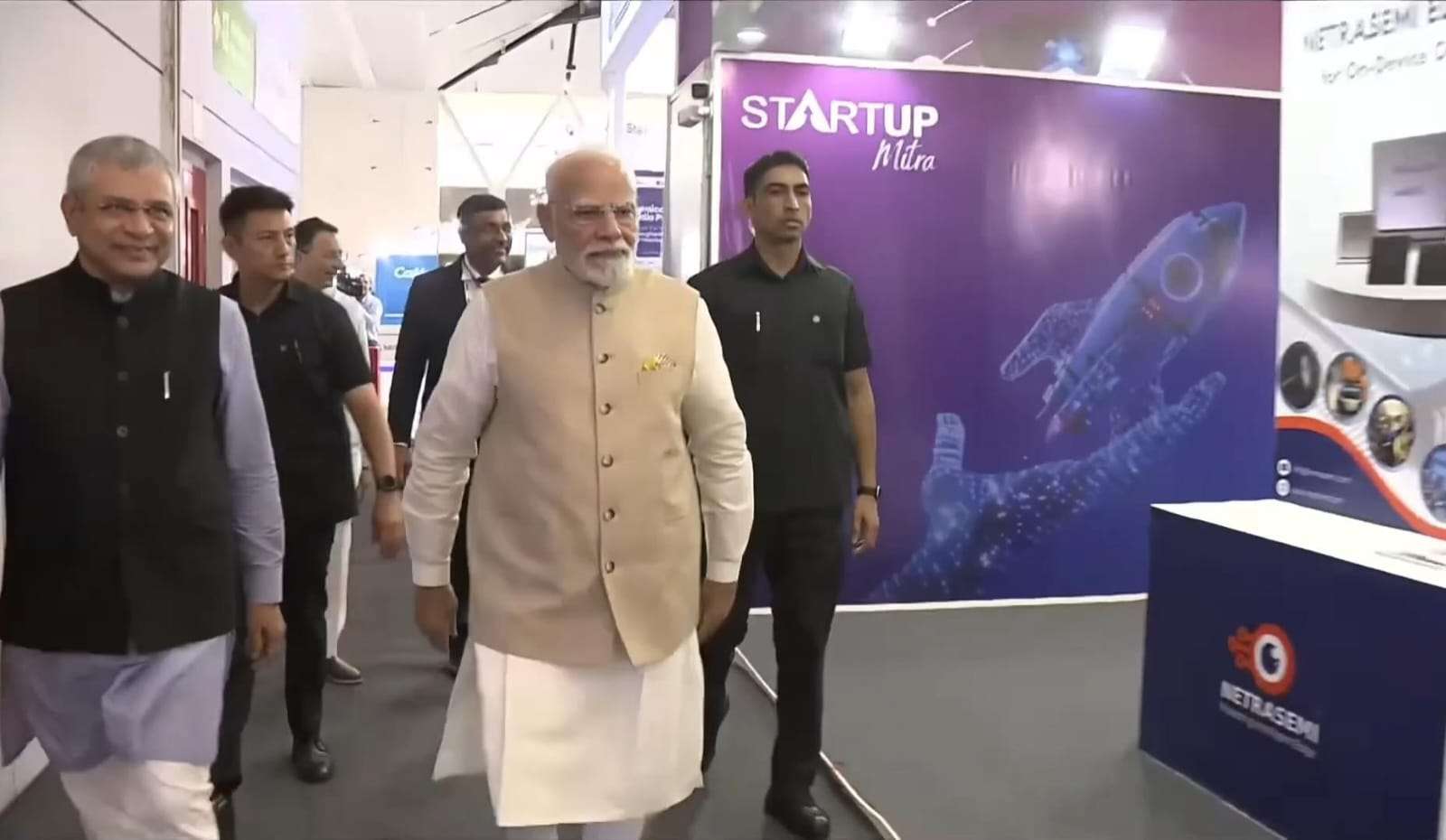
The highlight of the event was the visit of Prime Minister Narendra Modi, who toured the exhibition floor and interacted with global CEOs, innovators, and startups. He was joined by Union Minister Ashwini Vaishnaw, Minister of State Jitin Prasada, and S Krishnan, Secretary, MeitY, reaffirming the government’s strong commitment to building a world-class semiconductor ecosystem in India.
SEMICON India 2025 welcomed 21,000 unique visitors, hosted 1,275 booths (350 exhibitors) across 25,000 sq meters, and registered 35,000+ attendees from 48 countries. With more than 30,000 footfalls, the exhibition became a global meeting ground for collaboration, innovation, and partnerships.
During his walkthrough, the Prime Minister visited booths of leading global technology companies and country pavilions, witnessing live demonstrations of breakthrough technologies. He interacted with senior global leaders, including Christophe Fouquet (ASML), Dr Randhir Thakur (Tata Electronics), Prabhu Raja (Applied Materials), Rangesh Raghavan (LAM Research), Tony Kawai (Tokyo Electron), Ahmad Khan (KLA), Gursharan Singh (Micron), Dr Mukesh V Khare (IBM Semiconductors), and Raghu Panicker (Kaynes), among others.
At the Startup Mitra Pavilion, the Prime Minister engaged with emerging innovators showcasing design-led semiconductor solutions. Notable founders included Vrinda Kapoor (3rd iTech), Pratap Narayan Singh (Vervesemi Microelectronics), Gautam Kumar Singh (Fermionic Design), Anantha Kinnal (Calligo Technologies), and Jyothis Indirabhai (Netrasemi). Their work highlighted India’s growing strength in chip design for strategic, industrial, and consumer applications.
The exhibition featured four country pavilions (Japan, Korea, Singapore, Malaysia) and eight state pavilions (Gujarat, Tamil Nadu, Karnataka, Odisha, Maharashtra, Assam, Haryana, Uttar Pradesh), each showcasing their unique capabilities, policy frameworks, and opportunities within the semiconductor ecosystem.
Ashok Chandak, CEO & President, SEMI India and IESA, stated “The Prime Minister’s direct engagement with CXOs, startups, and international delegations has reinforced India’s resolve to become a global semiconductor powerhouse. This exhibition set new benchmarks for collaboration and investment opportunities. We are confident that SEMICON India 2026 will build on this momentum, driving innovation, self-reliance, and global partnerships.”
During the visit, the Prime Minister witnessed a series of groundbreaking demonstrations highlighting India’s growing capabilities in advanced technologies. Among the key showcases were Plasma and EBR tools designed for next-generation chip manufacturing, along with cutting-edge Digital Twin solutions that enable real-time simulation and optimization of semiconductor production equipment. AR glasses were also presented, offering immersive training and servicing experiences that redefine how complex systems can be operated and maintained.
The exhibition further included a life-sized replica of the iconic IBM Quantum System Two chandeliers, symbolizing India’s progress in quantum computing. Visitors were also shown a state-of-the-art Semiconductor Chamber cleanroom, underscoring the country’s readiness for upcoming technological breakthroughs.
Additionally, India’s own designed chips were unveiled, tailored for strategic defense applications, enhanced energy efficiency, artificial intelligence, and the development of 6G-ready devices—reinforcing the nation’s ambition to lead in frontier technologies. Exhibitors praised the exhibition for generating high-quality B2B leads, strong supply chain connections, and new investment opportunities, affirming SEMICON India’s role as a catalyst in advancing India’s semiconductor industry.