

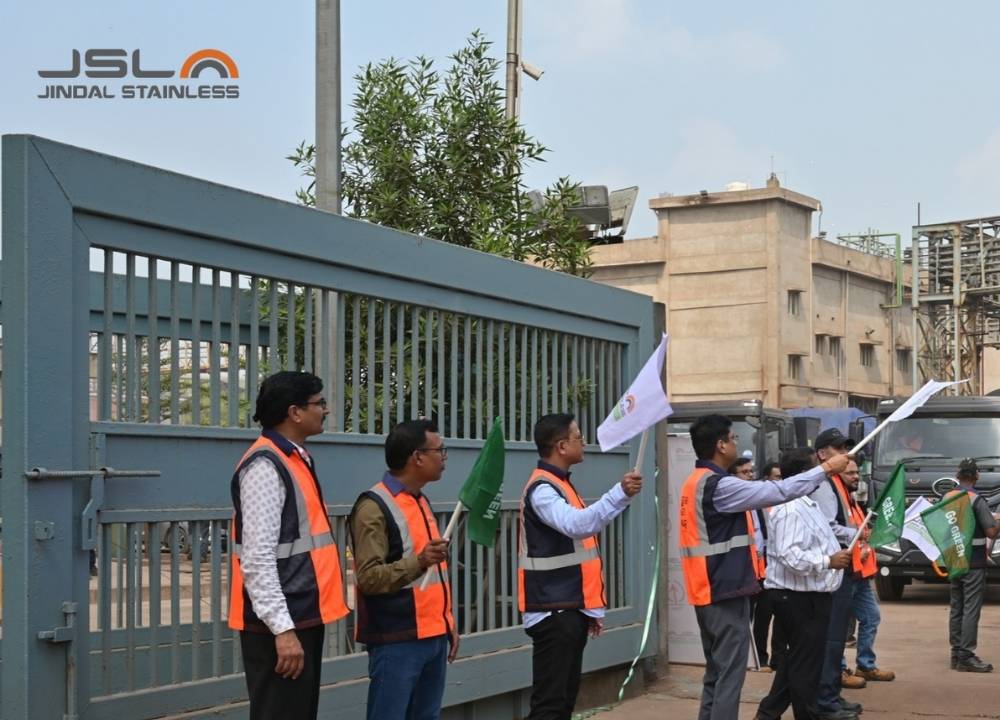
Jindal Stainless has deployed 10 electric trucks for finished goods transportation for the first time, expanding its green mobility programme and efforts to reduce emissions across its logistics operations. The trucks will operate on routes connecting the company’s Jajpur plant with Kharagpur and Kolkata.
The deployment is part of a phased transition towards electric and alternative-fuel vehicles across the company’s transportation network. Along with electric trucks, Jindal Stainless is using liquefied natural gas (LNG) and compressed natural gas (CNG) vehicles to reduce its dependence on diesel-powered transportation.
The company currently operates 80 LNG trucks to transport finished goods from its Jajpur and Hisar facilities to western India. It has also started deploying CNG trucks to move imported cargo from Dhamra to Jajpur. In addition, 60 CNG buses are being used for employee transportation at its Hisar and Jajpur facilities.
Together, these initiatives are expected to support the movement of approximately 8,000 to 10,000 tonnes of cargo every month using electric and alternative-fuel vehicles. Jindal Stainless plans to expand the use of these vehicles across suitable routes, depending on operational requirements and the feasibility of adopting different transportation technologies.
Abhyuday Jindal, Managing Director of Jindal Stainless, said, “We believe that responsible manufacturing must extend beyond our plants to the entire value chain, including the way we transport our products. The deployment of electric trucks marks an important milestone in our efforts to decarbonise logistics and integrate lower-emission transportation solutions into our operations. Our approach is focused on adopting practical, scalable solutions that reduce our environmental footprint while maintaining operational efficiency. We will continue to advance such initiatives as part of our commitment to ESG goals.”
Based on a modelled monthly green dispatch volume of 8,000 to 9,000 tonnes and an equivalent truck travel distance of approximately 240,000 kilometres, the combined use of electric, CNG and LNG vehicles is expected to reduce carbon dioxide emissions by around 71 tonnes per month. This represents an estimated reduction of approximately 26% compared with diesel-based transportation under regular operating conditions. The green mobility programme complements the company’s broader environmental measures, which include improving energy efficiency, increasing renewable energy use and strengthening resource circularity across its operations.
Jindal Stainless had an annual turnover of ₹42,955 crore in FY26 and an annual stainless steel melt capacity of 4.2 million tonnes. Founded in 1970, the company operates manufacturing and processing facilities in India and overseas, including Spain and Indonesia. Its product portfolio includes stainless steel slabs, blooms, coils, plates, sheets, precision strips, wire rods, rebars, blade steel and coin blanks.









