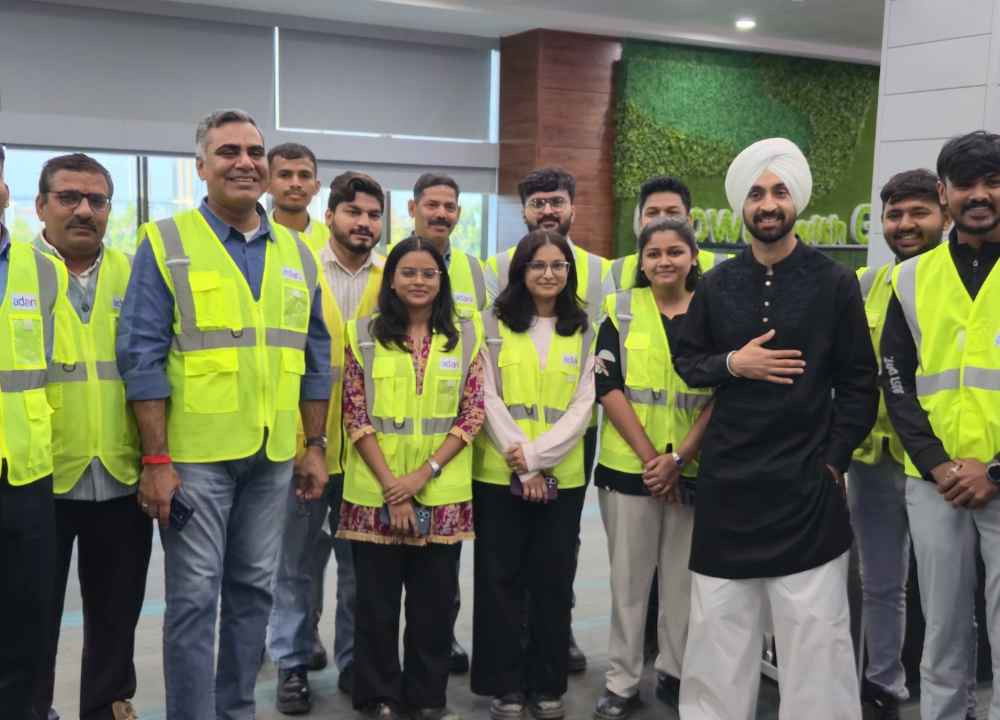
Global music icon Diljit Dosanjh recently visited the Adani Group’s Khavda Renewable Energy Project in Gujarat, where he witnessed the scale of one of the world’s largest renewable energy and battery storage developments. The visit took place during the Gujarat leg of his national concert tour.
“Bohot Vadhiya (this is too good!),” said Dosanjh, expressing his appreciation for the project and India’s progress in renewable energy. Spread across 538 sq km in the Kutch region, the Khavda site is located in a remote saline landscape, more than 70–100 kilometres from the nearest human settlement.
During the visit, Dosanjh interacted with site engineers to understand the logistical and engineering challenges involved in developing the large-scale facility in such a location. He also acknowledged the efforts of the Adani Green Warriors working on the project.
From the site’s viewing tower, Dosanjh saw the extensive network of solar panels and wind turbines. He subsequently visited the central control room, where the project team demonstrated how operations across the facility are monitored and managed through digital systems. As part of the visit, he planted a sapling at the site.
The Khavda team presented the singer with a piece of Rogan art, a traditional craft associated with the Kutch region, along with an Ajrakh-print scarf, highlighting the area’s cultural heritage. The 30 GW Khavda Renewable Energy Project has already achieved more than 11 GW of operational renewable energy generation capacity. Once completed, the project is expected to comprise 26 GW of solar and 4 GW of wind power, making it a major contributor to India’s clean energy capacity.
The site also houses a 6.63 GWh Battery Energy Storage System (BESS), described as the world’s largest operational battery storage installation at a single location. It accounts for more than 50% of India’s total operational BESS capacity and is designed to support grid stability and the supply of renewable power around the clock. The project is ultimately planned to include 50 GWh of battery storage.
More than 15,000 people are currently involved in developing the facility, which covers an area five times the size of Paris. Once completed, the project is expected to generate enough electricity to meet the annual requirements of more than 17 million homes. Executed by Adani Green Energy Limited (AGEL), Khavda is a key part of the Adani Group’s planned investment of around USD 100 billion over five years in India’s energy transition. The project is also expected to support the country’s target of achieving 500 GW of non-fossil fuel-based energy capacity by 2030. Adani Green Energy aims to make Khavda the world’s largest power plant across all energy sources by 2029, positioning the project as a major development in India’s renewable energy expansion.