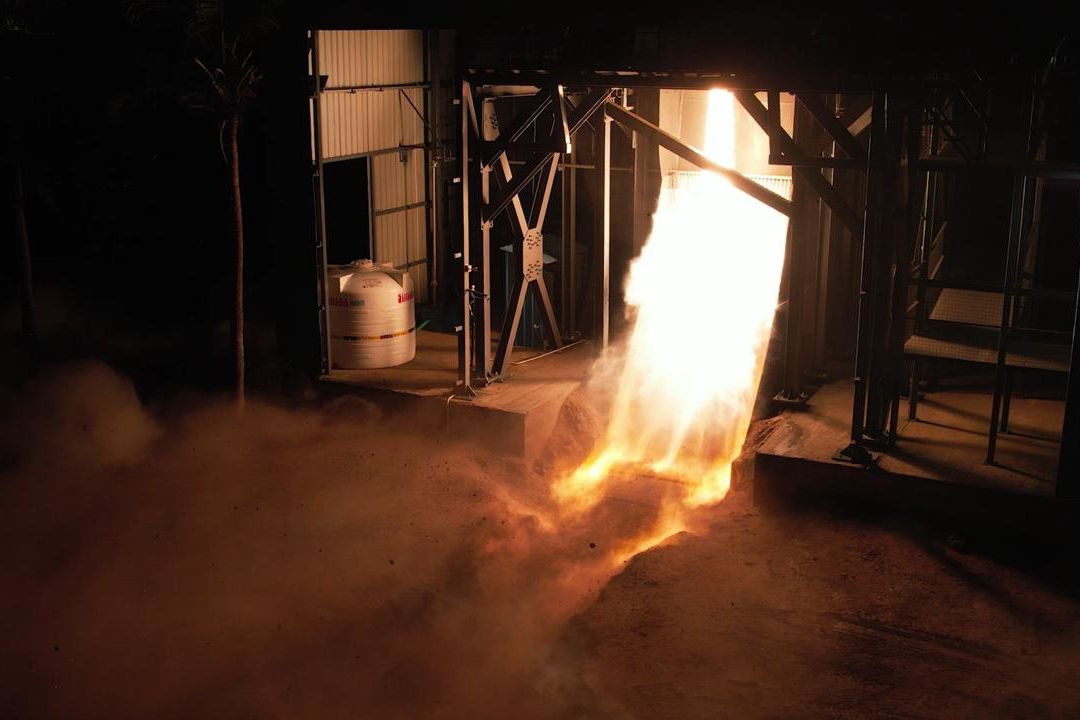
Agnikul Cosmos has achieved a major milestone in its propulsion programme with the successful testing of its booster engine, Agnite, showcasing a new level of large-scale 3D printing in rocket manufacturing. The development highlights the company’s ability to produce complete rocket engines in approximately seven days, significantly reducing timelines compared to conventional methods that typically require several months.
The tested engine measures one metre in length and has been manufactured as a single-piece Inconel structure, making it one of the largest of its kind. It is also the first engine at this scale to be tested using electrically driven pumps, representing a shift toward simplified, high-efficiency propulsion systems. The test was conducted at the company’s dedicated facility in Chennai and marks a step forward in building scalable and repeatable launch capabilities.
By compressing production timelines, the company aims to enable faster launch readiness, potentially reducing waiting periods for satellite missions from months or years to a matter of days. This capability is particularly relevant for customers requiring dedicated launch slots, precise orbital placement, and flexibility in mission planning.
Agnikul’s integrated approach brings together vehicle manufacturing, propulsion systems, mission control, and ground infrastructure under a single operational framework. This consolidation reduces dependencies across multiple stakeholders, allowing customers to engage with one provider from initial planning through to on-orbit deployment.
The company’s propulsion development has progressed through a series of incremental tests, including a recent demonstration involving the simultaneous firing of three semi-cryogenic engines. The latest booster test builds on these efforts and is considered one of the most important advancements since its controlled ascent mission in 2024.
According to company leadership, the design choices behind the engine—such as single-piece construction and electric pump systems—are aimed at reducing complexity, improving reliability, and supporting reusability goals. These factors also contribute to faster turnaround between launches.
With propulsion risks significantly reduced, the company is now focusing on achieving consistent launch frequency and execution reliability. The goal is to support a wide range of missions, including satellite constellations, technology demonstrations, government programmes, and emerging applications such as space-based computing.
Backed by recent investments and supported by a growing manufacturing base, Agnikul is positioning itself to meet increasing demand for responsive, dedicated launch services. The company’s approach reflects a broader shift in the space sector toward faster, more flexible, and customer-driven access to orbit.