India’s freight sector moves on diesel. Around 10 million commercial vehicles operate on Indian roads, and for decades, the question of what would replace diesel in heavy trucking remained largely theoretical. The economics never quite aligned. The infrastructure was not there. The financing community was hesitant. Fleet operators, who measure everything in total cost of ownership and uptime, were not about to experiment with technology that had no track record in Indian conditions. Blue Energy Motors entered this environment in 2020 with a deliberate decision: if you are going to build trucks in India, do not build the same truck that already exists.
“Diesel is one of the most taxed commodities today in the country,” says Anand Mimani, CEO of Blue Energy Motors. “Carbon dioxide saving is a very important mission for everybody. When you look at those two or three points from an opportunity perspective, alternate fuel is what comes to mind.” The company launched India’s first LNG trucks and has since expanded into electric vehicles. Four years in, it holds approximately 80 percent market share in India’s combined LNG and EV truck segment, with more than 1,200 to 1,300 vehicles running on Indian roads. Manufacturing capacity stands at 10,000 LNG and EV vehicles annually. Getting to that position required building far more than a truck.
Building an Ecosystem, Not Just a Truck
When Blue Energy Motors started, the supporting infrastructure for LNG trucks in India was close to non-existent. LNG pumps were limited. Fleet operators were unfamiliar with the fuel. Financial institutions had not yet built risk frameworks for alternate fuel vehicles. The capital cost of an LNG truck is roughly double that of a comparable diesel vehicle at the time was a significant barrier. “Limited LNG pumps across India. Financing was a challenge because even financial institutions and risk committees were not willing to clear it so easily,” Mimani explains. “These were the primary challenges.”
The company’s approach was to address each barrier directly rather than wait for the market to solve them. Blue Energy Motors installed its own fuelling stations to address infrastructure gaps, deployed vehicles on a continuous basis to build a performance record, and used that track record to gradually open up financing. Today, 30 LNG pumps are operational across India, and lenders are beginning to finance these vehicles with considerably less friction.
One market shift that helped was external. Global fuel supply volatility over the last few years has pushed more fleet operators to evaluate alternatives to diesel. “Problems happening around the world have also boosted the case that alternate fuel should be looked at by everyone,” Mimani says. The product itself also opened up segments that conventional truck configurations had not reached. In FMCG logistics, for instance, the standard configuration had been DC 32-feet rigid bodies. Blue Energy Motors introduced 46-feet containers for the same segment, allowing customers to carry more volume per trip and improving the economics of the switch.
Why Energy-as-a-Service Matters
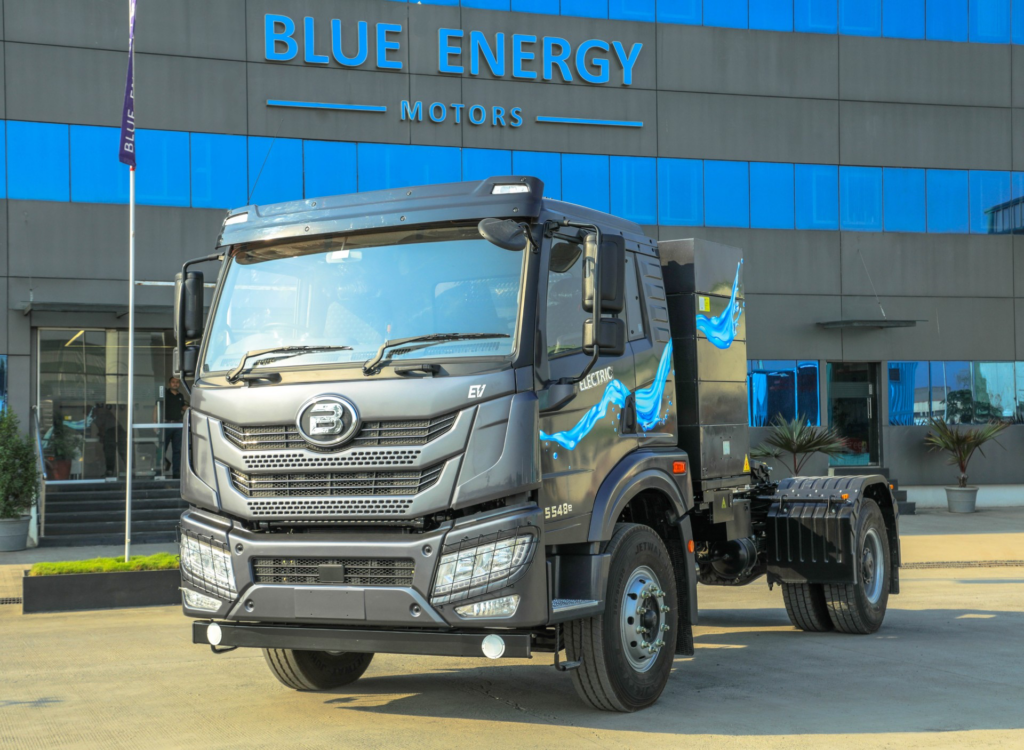
The capital cost barrier did not disappear entirely with LNG. For electric vehicles, it was more pronounced. A diesel 55-tonne truck might cost around Rs 30 lakh. An equivalent EV with battery systems could reach Rs 90 lakh. Blue Energy Motors’ response was to restructure the ownership model. For its EV customers, the company retains ownership of the battery on its own balance sheet. The customer buys the truck at a significantly lower price point – around Rs 55 lakh and does not carry battery-related risk.
“We said we’ll own the battery. Battery is nothing but a fuel for us,” Mimani explains. “We’re getting a 55 lakh vehicle, which is more comfortable for the transport segment to assess and venture into EV. Our skin is in the game with them.”
The practical effect is that a fleet operator who was previously weighing a Rs 90 lakh commitment against a Rs 30 lakh diesel alternative is now comparing a Rs 55 lakh EV against the same diesel option. The economics shift considerably. Battery swap infrastructure; what the company calls the next-generation fuel pump is being built alongside this model. Batteries are managed, monitored, and maintained by Blue Energy Motors, removing a layer of technical uncertainty from the operator’s side.
The model reflects a broader shift in industrial equipment markets, where asset-intensive companies increasingly sell access and outcomes rather than hardware alone. For fleet operators focused on uptime and profitability, the appeal is straightforward: focus on running the truck, not on managing the battery technology behind it.
Commercial Vehicles Are Becoming Data Platforms
LNG vehicles require approximately 120 sensors built into the engine system. Every parameter fuel flow, temperature, pressure, combustion quality generates continuous data. For Blue Energy Motors, that data has become a central part of the product offering. The company operates a command centre that monitors every vehicle in its fleet in real time. Telematics data flows in from trucks running 24 hours a day, covering vehicle health, fuel efficiency, driver behaviour, gear change patterns, and maintenance cycles.
“We come to know in advance if anything is going to go wrong,” Mimani says. “We can call the driver, tell them when they need to come in for servicing, when any part is approaching trouble, so that their uptime is well insured.” In trucking, a vehicle off the road is revenue lost. A breakdown mid-route is not just a maintenance cost, it affects delivery commitments, driver schedules, and customer relationships. Predictive maintenance, by identifying problems before they cause downtime, changes the economics of fleet operation directly.
Driver performance data adds another dimension. Gear change timing, braking patterns, speed management – each behaviour affects fuel consumption and vehicle wear. When that data is visible to fleet managers, training can be targeted and improvements can be measured. “Helping the captains as well as the promoters of logistics companies to know in real time how the vehicle is performing, how it can do better, how fuel mileage averages can improve, this is how we are using telematics data,” Mimani says. The shift is significant. A truck is no longer just a mechanical asset producing tonne-kilometres. It is a connected machine generating performance data that operators can use to improve margins.
Manufacturing for the Energy Transition
India’s auto component supplier base is, as Mimani puts it, “a work in progress” when it comes to alternate fuel vehicles. Batteries are still largely imported. Cell manufacturing does not yet exist at scale in India. Blue Energy Motors manufactures its chassis and core truck structures locally. Battery pack lines are being set up domestically. The company’s supplier development work is ongoing an annual localisation programme that advances incrementally.
Mimani is clear-eyed about the timeline. “In the next two to three years, most of the supplier base, as they are evolving their production facilities and R&D investments, would cover a significant portion of what currently gets imported.” He is also direct about the risk facing domestic manufacturers if imported vehicles, particularly from China, are allowed to enter the Indian market in volume without adequate policy protection. “If fully built vehicles are continuously imported, companies like us who are working hard on developing products with our vendor partners, all that investment will slow down.” The message to policymakers is: Make in India, in the alternate fuel vehicle segment, requires a long enough runway for domestic manufacturers to build the supplier ecosystem before import competition makes that investment unviable.
What the Next Decade of Freight Mobility Could Look Like
Mimani does not expect a single technology to win the heavy trucking market. His view; consistent with what is already visible in markets like China is that LNG, electric, and eventually hydrogen will serve different use cases simultaneously. China started with LNG trucks about seven or eight years ago, then moved into EVs. Today, more than 50 percent of new heavy trucks produced in China are on alternate fuels. India, in Mimani’s view, is on the same trajectory but running several years behind. “I believe there is enough room for everyone; diesel, EV, LNG, CNG, and hydrogen as a future technology. They would all be there,” he says.
Hydrogen remains early-stage for commercial vehicles. The total cost of ownership does not yet support deployment at scale. But in five to ten years, Mimani expects it to mature as an option, particularly for applications where battery charging time and weight are constraints. The more immediate shift is in what the industry needs to do now: embed the current generation of alternate fuel technologies deeply enough that the economics becomes self-evident to fleet operators who have not yet made the transition.
India’s commercial vehicle market is expected to grow from around 4 million vehicles toward 8 million. A growing market means more new vehicles entering service and a larger share of those entering as alternate fuel units is the direction the industry is moving. The transition to cleaner freight, as Mimani frames it, is not a single technology decision. It is an accumulation of infrastructure, financing, manufacturing, data capability, and sustained commercial deployment built over years.