As India’s manufacturing sector steadily moves towards higher productivity and global competitiveness, the focus is shifting to what happens around the machine. How tools are stored, how materials move, and how efficiently the shop floor is organised. Pune-based Brahmand Engineers Pvt Ltd is working precisely in this space, offering 5S-based shopfloor solutions designed to improve efficiency, safety, and workflow.
Established in 2012, Brahmand Engineers has evolved from a die and mould background into a product-focused company catering to industrial 5S system implementation. Today, with a portfolio of over 45 products, including tool trolleys, assembly tables, ESD workbenches, tool cabinets, and material-handling systems, the company serves a wide range of industries with practical, affordable solutions.
At the upcoming TAGMA Die & Mould India 2026, to be held at the Bombay Exhibition Centre in Mumbai, Brahmand Engineers will present its range of shop-floor productivity solutions to the die and mould ecosystem. In an interaction with Machine Maker, Amar Singh Thakur, Director of Brahmand Engineers, shares the journey, vision, and approach behind the company’s growth.
From Toolroom to Transformation: Identifying the Gap in MSME Shopfloors
Brahmand’s journey began with a strong foundation in die and mould manufacturing. However, early on, the team identified a critical gap in shopfloor processes and organisation. “We started around 2012 as a die and mould company. But we saw a gap, MSMEs were not following structured processes like lean manufacturing, which are common in Japanese or German systems,” says Amar Thakur.
This observation led to a shift in thinking. Instead of focusing solely on machining, the company began exploring ways to improve shopfloor efficiency through better tool management and workplace organisation. “Our initial aim was to cater to tool management requirements for MSMEs, especially those with low investment capacity. We wanted to create simple, practical solutions,” he explains.
What started as an internal effort to manage tools within their own machining setup soon evolved into a larger opportunity. While searching for suppliers for basic shopfloor systems, the team realised that the Indian market lacked partners willing to develop new, application-driven products. “When we searched for suppliers, we found that many were making cabinets or storage systems, but they were not open to developing new products. That’s when we decided to manufacture ourselves,” says Thakur.
This led to the formal establishment of Brahmand Engineers Pvt Ltd in 2019, with a focus on designing and manufacturing sheet metal-based industrial products. Leveraging their design strength, the company began building solutions tailored to real shopfloor challenges. “Designing was always our strength. So we started manufacturing our own products and gradually expanded our range,” he adds.
Today, the company offers a growing portfolio that caters to tool storage, material handling, and workstation optimisation across industries.
Driving 5S and Lean Thinking in Indian MSMEs
A key pillar of Brahmand’s approach is the implementation of 5S principles—sorting, setting in order, shining, standardising, and sustaining within manufacturing environments. Amar believes that while these concepts are deeply rooted in global manufacturing practices, they are often overlooked in Indian MSMEs. “5S is actually part of our culture; we keep things clean and organised in our daily lives. But in industry, especially MSMEs, we often don’t follow these processes,” he points out.
“Our vision is to empower MSMEs by improving their shopfloor efficiency. Many companies focus on customers and production, but they miss their internal shopfloor needs—like organisation and safety,” he explains. What initially began with a limited product range has expanded significantly as the company engaged with diverse industries and applications.
“When we started, we thought 20 products would be enough. Today, we have over 145 products, because every industry has different needs,” says Mr Thakur. From automotive and die & mould to defence, aerospace, and even pharmaceuticals, Brahmand’s solutions are finding relevance wherever storage, movement, and organisation are critical. “Wherever storage is needed, or material movement is involved, we can contribute. Even industries like pharma, which seemed difficult initially, are now working with us,” he adds.
Despite being a local manufacturer, the company emphasises that its products are designed to meet global standards while retaining a cost advantage. “We are creating products and adding value for MSMEs. Our quality matches international standards, but we have the advantage of local pricing,” he says.
Showcasing Practical 5S Solutions at TAGMA Die & Mould India 2026
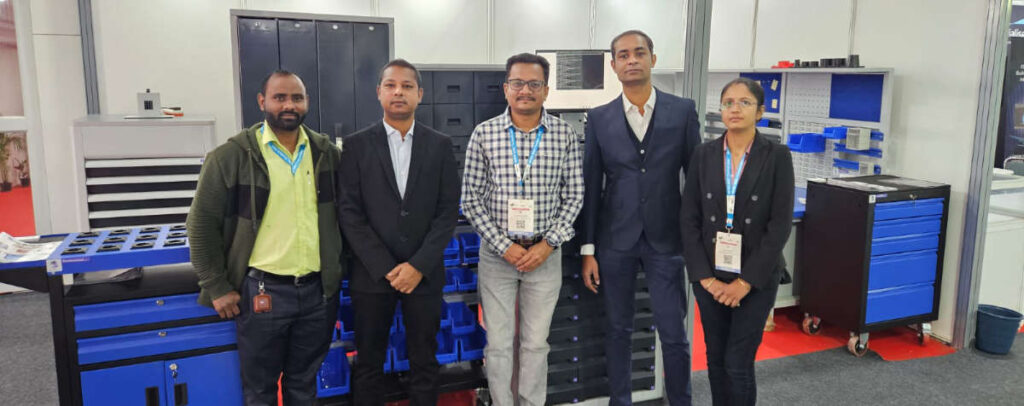
At the upcoming TAGMA Die & Mould India 2026, Brahmand Engineers will present a focused set of solutions designed to address everyday shopfloor challenges in toolrooms and manufacturing environments. The company is bringing six key products that represent its core approach towards tool management, storage, and workflow efficiency.
“We are coming with six products. First is our tool management system, which is an Industry 4.0 product. Apart from that, we have VMC tool trolleys, tool trolleys, workbenches, cabinets, and bin storage trolleys,” says Amar Thakur. Among these, the tool management system stands out as a key highlight. While it was not showcased earlier at TAGMA due to its early stage of development, the company introduced it at IMTEX Bengaluru, where it received an encouraging response from the industry.
“At IMTEX, we got a very good response and even started receiving orders. This time at TAGMA, we are confident it will connect well with the die and mould industry,” he adds. Beyond individual products, Brahmand’s focus is on enhancing the overall shopfloor experience, bringing the same level of quality and usability that people expect in their daily environments into industrial settings.
“If we use good quality products on the shopfloor, people automatically take more care in their work. That mindset shift is very important,” notes Amar Thakur.
TAGMA as a Platform for Learning, Engagement, and Growth
For Brahmand Engineers, TAGMA is a space for meaningful engagement with the die and mould community. “TAGMA is a very focused exhibition. Almost all exhibitors and visitors are our potential customers. Even if we don’t get additional visitors, the ecosystem itself is our market,” says Thakur.
Having participated in multiple exhibitions over the years, the company considers TAGMA one of the most impactful platforms for the tooling industry. “We have done around 14–15 exhibitions, but I would rate TAGMA among the top three. It is very organised and technology-driven,” he adds.
What makes TAGMA particularly valuable, according to him, is the quality of interactions. The visitors, primarily toolmakers and industry professionals, bring a deeper understanding of applications and often challenge exhibitors with practical questions. “People at TAGMA ask tough questions. They have a different perspective. It helps us think differently and improve our products,” says Mr Thakur.
This makes the exhibition a platform for learning and product development. “For us, TAGMA is about branding, about gaining knowledge, understanding new requirements, and improving our offerings,” he adds.
Understanding 5S: From Awareness to Implementation on the Shopfloor
At the core of Brahmand Engineers’ approach lies the concept of 5S—a Japanese methodology that focuses on organising and maintaining an efficient workplace. While widely adopted in global manufacturing systems, its structured implementation still remains limited across many Indian MSMEs. Explaining the concept, Amar Thakur says, “5S means sorting, setting in order, shining, standardising, and sustaining. In any industry whether die and mould, aerospace, or any manufacturing setup—every process needs to be organised.”
However, the challenge is not a lack of awareness but a gap in execution. Many MSMEs operate within long-standing habits and internal perceptions of organisation, which may not always align with structured systems. “In many cases, people feel things are already organised at their level. But when a third person looks at it, they realise something is missing. That is the gap 5S addresses,” he explains.
Brahmand’s approach is to simplify implementation through practical products that guide behaviour on the shop floor. Instead of relying solely on training or external audits, the company’s solutions create a natural workflow in which the organisation becomes part of daily operations. “To implement 5S, we don’t always need complex systems. Even basic products can bring discipline. For example, if we provide a tool trolley, tools automatically go there. If we have a tool holder trolley, the operator knows exactly where to keep it,” says Thakur.
The impact goes beyond storage as it introduces traceability, accountability, and better inventory control. “With systems like tool management, we can track where tools are going, who is using them, and how inventory is managed. It improves both accountability and efficiency,” he adds.
Importantly, 5S is not limited to the organisation alone; it directly contributes to multiple aspects of manufacturing performance. “5S is not just about cleanliness. It supports safety, preventive maintenance, tool management, and even assembly processes,” notes Amar Thakur. By integrating structured workstations, proper storage, and visual management tools, operators can focus on productive tasks rather than spending time searching for or managing resources.
“If everything has a fixed place, it becomes easy even for a new person to find it. The time wasted in searching reduces, and efficiency improves,” he explains. As Indian manufacturing continues its journey towards global competitiveness, the importance of disciplined, well-organised shopfloors cannot be overlooked. Brahmand Engineers is addressing this fundamental need by combining practical product design with the principles of 5S, making it easier for MSMEs to adopt structured systems without heavy investment or added complexity.