


There is a version of manufacturing where everything is figured out at the laptop before a single machine is turned on. Where an engineer can see exactly how a stamping die will behave in the real world before it is built, catch what will go wrong, and fix it at zero cost. Nishchhal Rai, Director of R&W Toolings, has spent the better part of six years trying to make that version the norm for India’s tool and die industry. It has not been a straightforward journey. But then, it rarely is.
Starting in a Pandemic
R&W Tooling Solutions was founded in 2019 by Nishchhal Rai and his partner Dyaneshwar Waman. Both come from automotive engineering backgrounds, Nishchhal spent time at Autoform India working on stamping simulations, and both had stints at companies like Tata and JBM before starting out on their own. The plan was to focus on cutting tool training. Then COVID arrived, six or seven months in, and shut everything down.
“No travel, no entry into companies. Everything was on halt,” Nishchhal recalls. “So we decided to start our engineering services business, because work from home was quite possible at that time.” It turned out to be a better pivot than they could have planned. Their stamping engineering background was exactly what companies under pressure needed. Mahindra became their first engineering services customer. R&W Tooling provided stamping simulations and simultaneous engineering support for automotive body development, along with die design services. From that foundation, the company has since grown into a business that serves automotive manufacturers across India and, notably, across Europe — with around 90% of its engineering services clients based in Germany, France, Italy, and other European markets.
The Product at the Centre of Everything
At TAGMA Die & Mould India 2026, R&W Toolings is focusing on two things: its engineering services and a stamping simulation software called Stampack Express, which it sells and supports as a sales and technical partner in India. The software is developed in Germany, and R&W Toolings has built a customer base of around 14 companies using it in India, with approval from five to six OEMs, primarily in western India.
Nishchhal is direct about what makes it stand out. Simulation software, he says, is a crowded space where a lot of vendors promise that what happens on screen will match what happens on the shop floor. Many do not deliver on that. “Case studies are the best thing to judge any software,” he says. “As a salesperson, a salesman can claim anything. But when you purchase a product and you don’t get the results, it is totally upsetting.”
R&W Tooling’s approach is the opposite of that. They tell customers clearly what the software can do and just as clearly what it cannot. No promises about future updates. No hedging. What is there today is what you get. “That is how we have gained trust. We do not make fake promises. Whatever is present today, you will get it. Whatever is not there, it is not there.”
In a market where SMEs are making their first significant software investments — committing real money to virtual assets that banks will not even accept as collateral — that kind of honesty matters more than any feature list.
Why Engineering Has to Come First
The deeper argument Nishchhal is making, through both the software and the engineering services, is about where quality in tool making is actually determined. “Every tool making starts with engineering of the product,” he says. “If you are weak in engineering, the product is going to fail when you manufacture it.”
Doing things on a laptop costs very little compared to what goes wrong on the shop floor. A mistake in simulation is a correction that takes hours. The same mistake discovered after weeks of machining is scrap: wasted material, wasted time, and a delayed launch in an industry where OEMs are always in a hurry to get the next model out.
This is the problem Stampack Express and R&W Toolings’ engineering services are both designed to solve. Get the engineering right before anything goes to the machine.
The Team as the Real Differentiator
When asked about his USP, Nishchhal does not lead with the software. He leads with the people.”My USP is my team,” he says. “Everything starts with them. If the team is good, you can take on any challenge.”
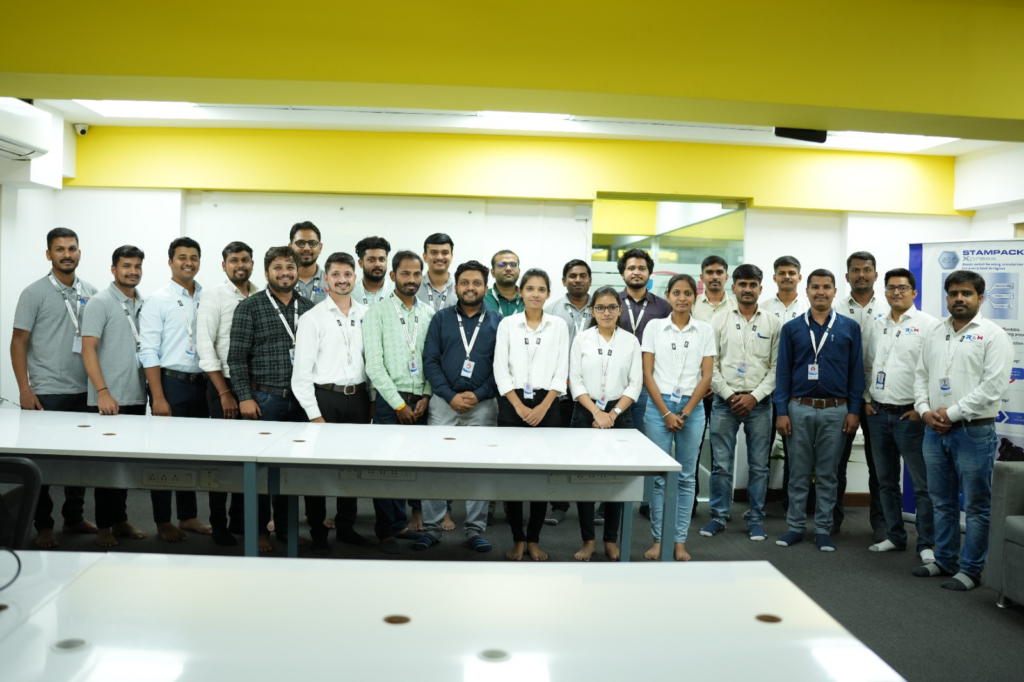
Most of R&W’s engineering team comes from OEM backgrounds. They understand how the other side of the table thinks, what OEMs expect, and how to make a part manufacturable in the real world when the drawing says otherwise. The company also invests in training fresh hires from colleges, building its own pipeline of people rather than depending entirely on experienced candidates.
Back at TAGMA After a Strong 2024
R&W Toolings participated in TAGMA’s previous edition and came away with over 100 leads across both the software and engineering services businesses. This year, the expectation is similar.
“TAGMA is one of the biggest showcasing events where tool and die makers visit,” Nishchhal says. “People from the north travel especially for it. People from Chennai, Karnataka, everyone is there.”
The target audience is straightforward: tool and die makers and OEMs who are either already using simulation software and want to evaluate alternatives, or who are considering making the move from hit-and-trial processes to structured simulation-based engineering for the first time.
For that second group especially, R&W Toolings’ message is simple. The industry is changing. Software that was once only for large companies is becoming accessible to SMEs. The ones that adopt it now, carefully and with the right partner, will be better positioned than the ones who wait.
“This industry is slowly going to adopt these tools,” Nishchhal says. “And when you are helping them make that decision, you have to be very fair about what you have and what you do not.”









