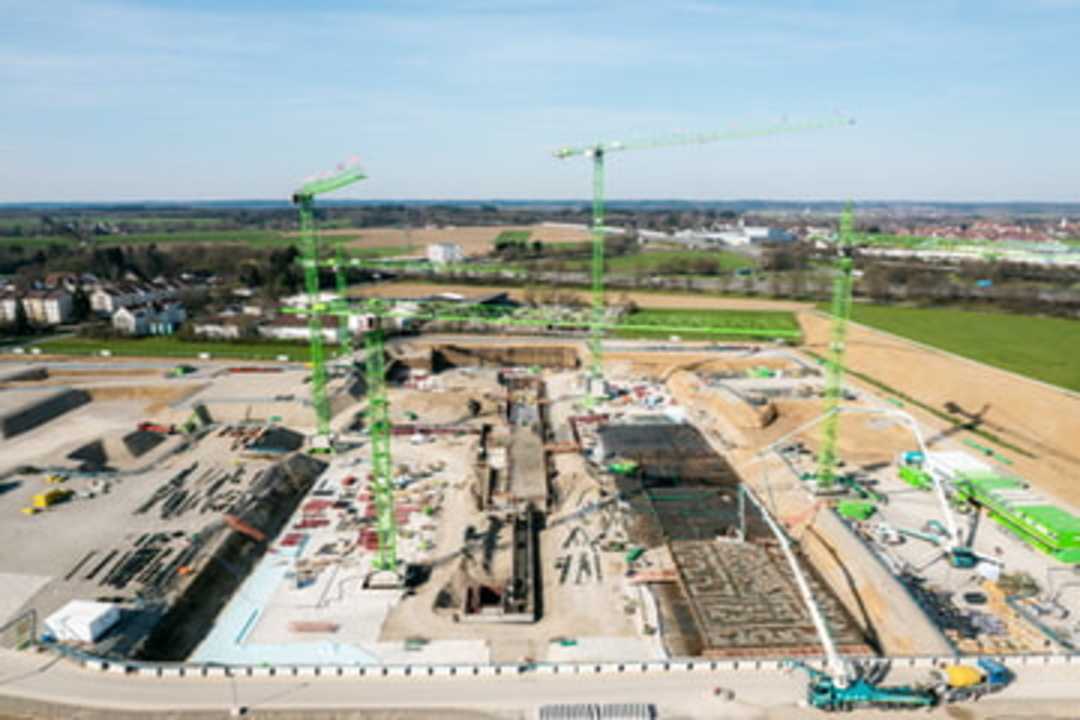
Construction of a new hospital complex in northern Memmingen is progressing steadily with the support of multiple tower cranes supplied by WOLFFKRAN. The large-scale healthcare facility is being developed on a 7.7-hectare site and will feature six floors, approximately 480 beds, and a total gross floor area exceeding 75,000 square meters.
Structural construction of the project began in February 2025, with six WOLFF tower cranes deployed on site to support the building process. The cranes have been painted in the distinctive green colour associated with the project’s contractor, Glass GmbH.
One of the cranes, a WOLFF 6531.12 Cross, was used during the early stages of site preparation and was dismantled in autumn 2025 after completing its initial tasks. The remaining five cranes continue to support construction activities and are expected to remain on site for an average deployment period of approximately 16 months.
Over the course of the project, the cranes are expected to handle nearly 60,000 cubic meters of concrete and approximately 10,000 tonnes of reinforcing steel. The equipment deployed at the site includes cranes capable of tip load capacities of up to 3.3 tonnes, maximum lifting capacities of 16.5 tonnes, and hoisting speeds reaching 185 meters per minute.
These capabilities allow the crane fleet to efficiently manage the high material volumes required for large-scale hospital construction. Since early 2025, the cranes have been operating for roughly 12 hours each day, enabling continuous progress on the building structure.
Beyond lifting performance, careful planning of crane placement played a critical role in the project’s execution. WOLFFKRAN contributed structural engineering expertise during the early planning stage to determine optimal crane positions within the construction site. Several crane bases were installed in areas that will later become light wells within the finished building. These sections include underground rainwater infiltration systems, which imposed strict limitations on allowable ground pressure.
Additionally, one crane location sits above a lower-level structure that will house a wastewater pumping station. Because heavy compressive loads were not permitted in these areas, engineers designed crane foundations that distribute loads safely into stable ground layers.
The cranes were installed on cross-frame foundations with special precast concrete counterweights produced by Glass GmbH at its own concrete facility. These counterweights can be removed individually during dismantling, allowing neighbouring cranes or mobile cranes to assist with removal while preserving the underground infiltration infrastructure. Despite overlapping working areas, the five active cranes have been positioned so they can operate simultaneously without interference, ensuring efficient material handling throughout the construction site.
According to Michael Stehr, Head of Crane Technology at Glass GmbH, successful execution of large projects like the Memmingen hospital requires close collaboration between construction teams and equipment providers. He noted that reliable cranes and early-stage technical planning are essential when significant volumes of construction materials must be moved daily.
Glass GmbH has worked with WOLFFKRAN for more than 14 years, building a fleet of 44 tower cranes. The company added eight new WOLFF cranes in the past year alone. In addition to the Memmingen hospital project, Glass is currently using WOLFF cranes on other major developments, including the expansion of the Daiichi-Sankyo pharmaceutical production facility in Pfaffenhofen and the construction of a new paper production plant for Fripa in Miltenberg. The Memmingen hospital project is expected to significantly enhance regional healthcare infrastructure while demonstrating the importance of precise engineering and reliable equipment in large-scale construction.