India is home to over 26.8 million persons with disabilities (PwDs) as per Census 2011, forming nearly 2.21% of our population, though the World Bank estimates this number to be much higher. Among them, wheelchair users make up a significant proportion. Yet, despite the progress in assistive technology, I’ve often noticed that mobility solutions for wheelchair users remain limited and largely dependent on others.
During my research, I came across a study based in Bengaluru (Devi, Goyal & Ravindra, 2013) that revealed 52% of wheelchair users face daily accessibility issues, with 77% calling it a ‘big’ issue. These numbers stayed with me. They represented real people facing real obstacles every day. Even though the government distributed 1.8 million assistive devices between 2013 and 2020 under various ADIPs (Assistance to Disabled Persons), the focus on integrated mobility solutions was missing. With the Indian wheelchair market projected to reach USD 216 million in 2024, I saw a clear gap between what’s available and what’s actually needed.
That’s where the idea for Auto-Morph began to take shape.
Every time I saw a person struggle to move from their wheelchair into a car seat, it deeply affected me. This seemingly small transition demanded physical effort, assistance, and emotional endurance. I began asking myself, “Could design make this process easier, more seamless and more dignified?”
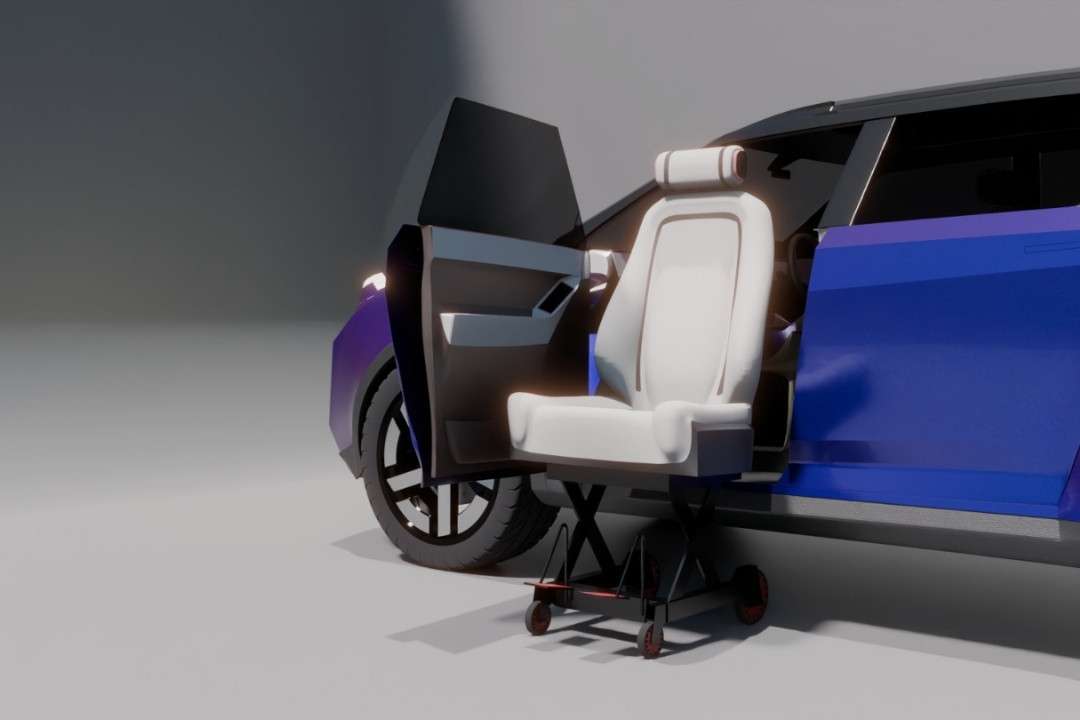
With that question in mind, I started working on Auto-Morph, a wheelchair that transforms into a car seat at the push of a button. My goal was to create something that empowers users to travel independently, without compromising safety or comfort. The armrests double as rails, helping users transition smoothly, while ergonomic cushioning reduces fatigue on long drives. Compact, efficient, and user-friendly, Auto-Morph was designed to move lives forward.
Throughout the process, I spoke to several wheelchair users to understand their daily experiences. Their feedback shaped every design decision I made. When they told me that Auto-Morph made them feel more independent and confident, I knew I was on the right track. They valued its compactness, calling bulky alternatives impractical for everyday use. But what touched me most was hearing how the seamless transfer feature reduced their stress, giving them a renewed sense of freedom. It reaffirmed my belief that thoughtful design can redefine accessibility and that good design doesn’t just solve problems, it restores dignity.
The journey of creating Auto-Morph would not have been possible without the ecosystem at Anant National University. The university’s flexible curriculum allowed me to combine my passion for product design and automobile engineering disciplines that rarely meet, but when they do, innovation happens.
The Makerspace and rapid prototyping facilities became my second home, where I could test, fail, and refine endlessly. Each prototype taught me something new about mechanics, user comfort, and most importantly, patience. I was fortunate to receive mentorship across disciplines, which helped me turn my vision into a functional, feasible reality.
The support from the Aarambh Incubation Centre was another helping hand as they guided me through design registration and patent protection, ensuring that Auto-Morph could move closer to real-world application. It gave me confidence that my concept was no longer an academic exercise; it had the potential to make a real difference.
As I continue refining Auto-Morph, my focus is now on scalable production and collaboration with industry stakeholders who share my vision for inclusive mobility. I see this as a movement towards self-reliance and empowerment for millions of people. What began as a classroom idea has grown into a life mission to ensure that mobility is a right, not a privilege.