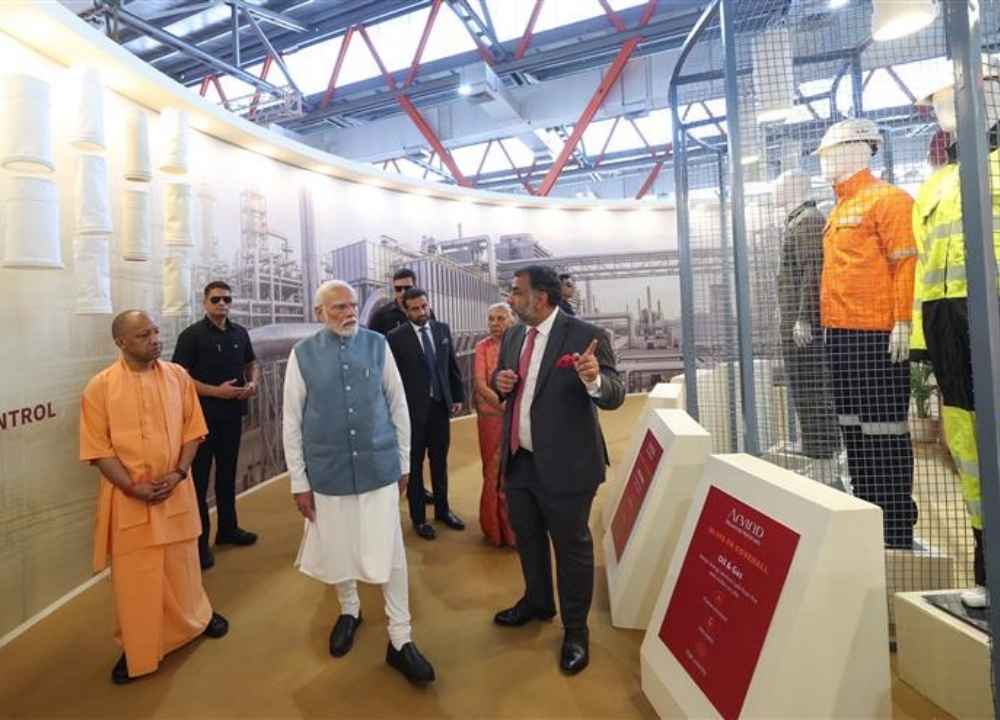
Prime Minister Narendra Modi inaugurated Arvind Limited’s new garment manufacturing facility in Varanasi, Uttar Pradesh, on October 25. The plant, developed with an investment of approximately ₹150 crore, is the company’s first manufacturing unit in the state.
The inauguration was attended by Uttar Pradesh Governor Anandiben Patel, Chief Minister Yogi Adityanath, senior government officials and industry representatives. Arvind Chairman Sanjay Lalbhai and Vice Chairmen Punit Lalbhai and Kulin Lalbhai accompanied the Prime Minister during his visit to the facility.
Spread across 5.5 acres, the plant has a built-up area of approximately 65,000 square feet. It has an estimated revenue potential of ₹250 crore and is expected to generate more than 1,000 jobs, with women expected to make up a significant share of the workforce.
The facility will manufacture knitwear products using automated sewing technologies. It will also process knitted fabric produced by Arvind, strengthening the company’s integration between fabric manufacturing and garment production. Sanjay Lalbhai said the investment continued the group’s history of contributing to India’s industrial development. He noted that the Lalbhai Group’s journey began in 1897 and said the Varanasi facility would create employment opportunities, particularly for women.
Punit Lalbhai said India had an opportunity to expand its role in global apparel manufacturing, supported by its textile value chain, workforce and demand for diversified sourcing. He added that investment in production capacity, productivity, sustainability and workforce development would be important to the sector’s growth.
Kulin Lalbhai said Uttar Pradesh’s infrastructure, connectivity, industrial development and skills initiatives were helping establish the state as a manufacturing destination. He said the textile and apparel industry could contribute to employment generation and long-term investment in the state.
The new plant is part of Arvind’s strategy to expand its garmenting business and strengthen vertical integration. By using its own knitted fabric, the company expects to broaden its product offering to existing customers and improve supply-chain coordination. The additional capacity is also intended to support opportunities in European and UK markets following recently signed free trade agreements.
The facility includes dedicated worker hostels, with plans to expand residential infrastructure as operations grow. Beyond direct employment, the project is expected to support local suppliers, logistics providers and other services. Arvind Limited operates across textiles, apparel, advanced materials, environmental solutions, telecom and omnichannel commerce. The company provides integrated fibre-to-fashion solutions to customers in India and international markets.