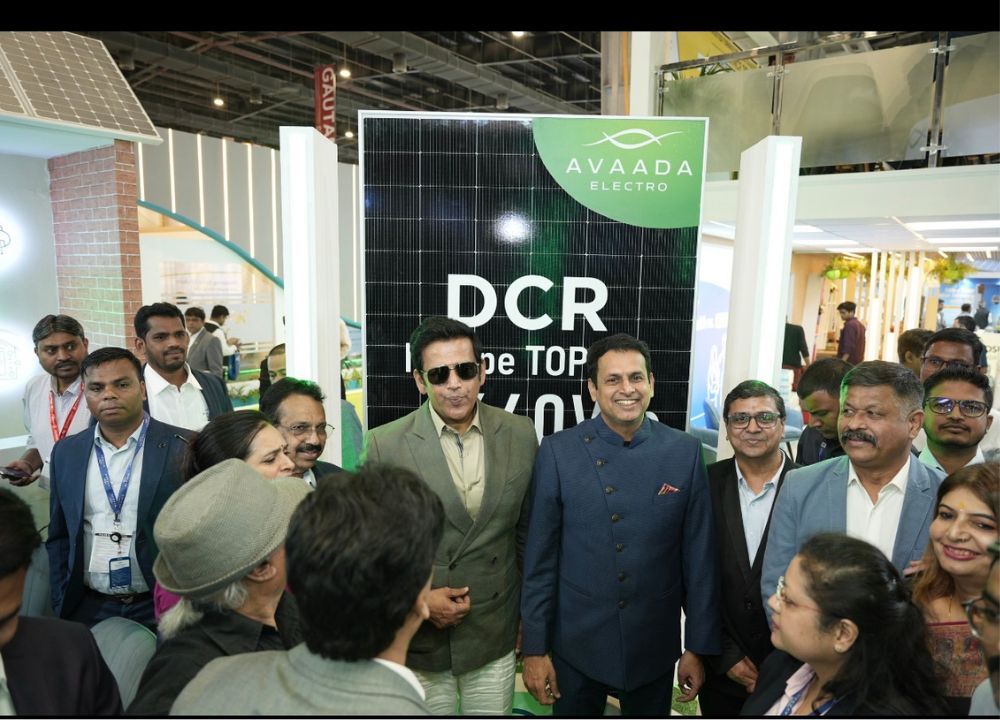
India can strengthen its energy security and reduce dependence on imported oil and gas by enabling every tehsil to become a power producer, said Vineet Mittal, Chairman of Avaada Group, at the Renewable Energy India Expo (REI Expo) 2026. Mittal said India’s solar and wind resources, combined with energy storage, could help provide reliable clean electricity throughout the day. He called for a shift from a “petro-state” to an “electro-state”, with decentralised power generation helping reduce pressure on the grid and limit exposure to global fuel supply disruptions.
“If every tehsil becomes a power producer, we can address power shortages, ease pressure on the grid and move closer to genuine energy self-reliance,” Mr Mittal said at the Avaada pavilion. Recalling a meeting with then Gujarat Chief Minister Narendra Modi in 2008, Mittal said early policy support helped establish the foundation for India’s solar industry. At the time, conventional thermal power cost around ₹3 per unit, while the solar tariff offered in Gujarat was approximately ₹15 per unit. Technological improvements, investment and increased production have since helped bring down solar power costs.
India has crossed 300 GW of non-fossil fuel-based power capacity. Mr Mittal said further progress would depend on investment in renewable generation, storage, transmission infrastructure and domestic manufacturing. He also highlighted the role of high-efficiency solar modules in rooftop installations, where available space can be limited. Avaada Electro’s 720 Wp solar modules are designed to generate more power from a given installation area.
Avaada Electro has 8.5 GW of solar module manufacturing capacity and 3 GW of solar cell manufacturing capacity across facilities in Uttar Pradesh and Maharashtra. The company plans to expand module capacity to 13.6 GW and solar cell capacity to 12 GW, alongside a proposed 3 GW ingot-wafer facility.
Actor and Gorakhpur MP Ravi Kishan visited the Avaada pavilion to explore rooftop solar solutions for his office in Gorakhpur. Having already installed solar panels at his residence, he is considering a similar installation at his office to reduce electricity expenses.
Mr Kishan said he was impressed by Mittal’s vision for India and his focus on extending development to villages. He said rooftop solar could help households and businesses lower electricity bills while contributing to national energy self-reliance. “This is the future. It will save you money, save the country and reduce our dependence on imports,” Mr Kishan said.
He also highlighted the potential for wider solar deployment in Gorakhpur, including a proposed 20 MW floating solar project at Chilua Tal and solar installations on railway station rooftops. He said he had raised the issue of expanding solar adoption with the Railway Ministry and in Parliament.
Both Mr Mittal and Mr Kishan said wider access to rooftop solar, decentralised generation, energy storage and domestic manufacturing would support India’s efforts to build a more affordable and secure energy system. Avaada Group is a diversified clean energy conglomerate focused on advancing India’s energy transition. Its business portfolio spans renewable power generation, solar photovoltaic manufacturing, green hydrogen and its derivatives, green data centres, battery energy storage and pumped hydro projects, supporting the development of a sustainable, reliable and low-carbon energy ecosystem.