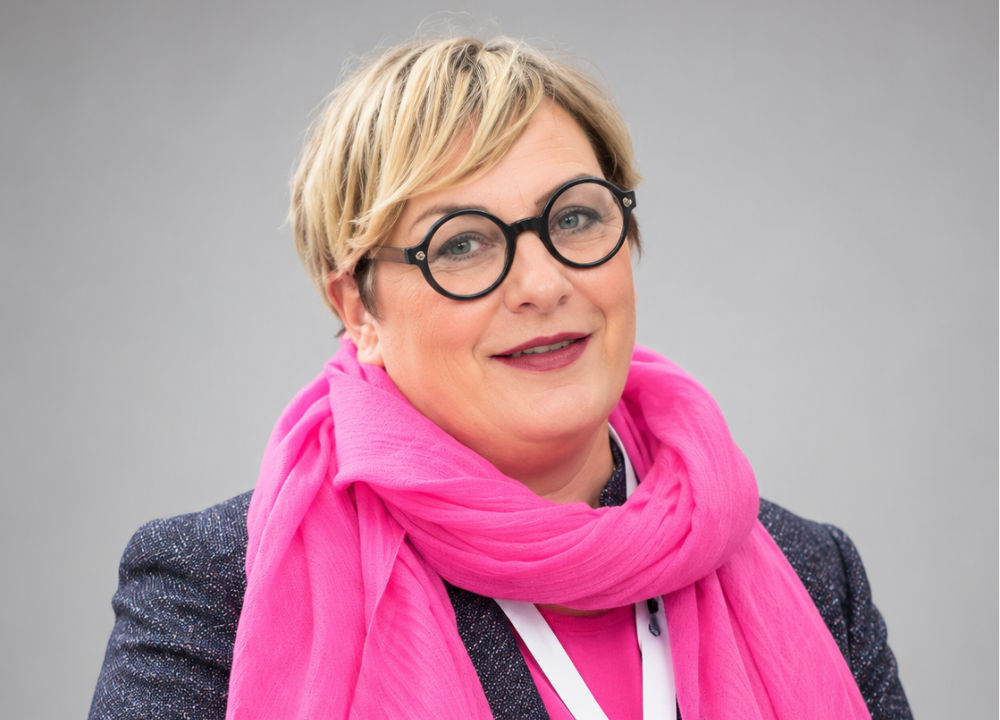
Seventy years after the Millutensil name was born in Italy, Veronica Just, CEO of Millutensil Innovation, tells Machine Maker why the Izano-based spotting-press specialist is heading to New Delhi this December, and why the future of Indian aluminium die casting will be decided as much in the die shop as on the casting floor.
In any die casting plant, the casting machine draws the eye. It is the largest, loudest and most expensive asset on the floor. But ask anyone who has spent a career in the trade where quality is truly won or lost, and the answer is almost always the same: in the die. A die that closes cleanly, seals evenly and has been properly spotted and maintained produces good parts, shift after shift. One that has not becomes a source of flash, scrap and lost hours.
That quiet but decisive corner of the industry is where Millutensil Innovation has built its reputation, and it is the conversation the Italian machinery maker intends to bring to India this winter. The company will exhibit at ALUCAST 2026, the 11th edition of India’s dedicated exhibition for the aluminium die casting and allied industry, from 10 to 12 December 2026 at Yashobhoomi (IICC), Dwarka, New Delhi, in collaboration with PROTOS INDIA.
Speaking exclusively to Machine Maker, Veronica Just, CEO, Millutensil Innovation, was clear about why the timing matters. “The continued development of aluminium die casting is transforming tooling requirements across the automotive and industrial sectors,” she said. “The growing demand for lightweight components, dimensional accuracy and efficient production processes makes die quality, preparation and maintenance more important than ever. That is exactly the conversation we want to have with Indian die casters.”
A family name, seventy years on
Millutensil’s story began on 27 July 1955, when the company was founded by Luigia Assi Just, initially selling wood processing machines. By 1968 it had become Fibro Germany’s exclusive agent in Italy for standard components for mould and die makers, and in 1971 it built its first spotting press prototype — for IBM — launching what the company still calls its Blue Line. A dedicated factory followed in 1988 at Izano, in the province of Cremona, and in the 1990s the Green Line (coil feeding and cutting lines) and Yellow Line (conveying and stacking systems) took shape.
Today the business is led by the second generation. Veronica Just, now CEO of Millutensil Innovation, and her sister Beatrice Just have worked in the company for many years, and in 2025, the brand’s seventieth year the operation was carried forward under a new name, Millutensil Innovation. Multinational groups operating plants worldwide use its spotting presses in die casting, plastic moulding, sheet metal, home appliance, medical, and rubber applications.
India is not new territory. Millutensil has been part of the Italian Technology Center network in Pune since 2013 and exhibited at IMTEX 2023. ALUCAST, however, puts the company directly in front of the audience its die casting range was built for.
Why a die casting die needs a press of its own
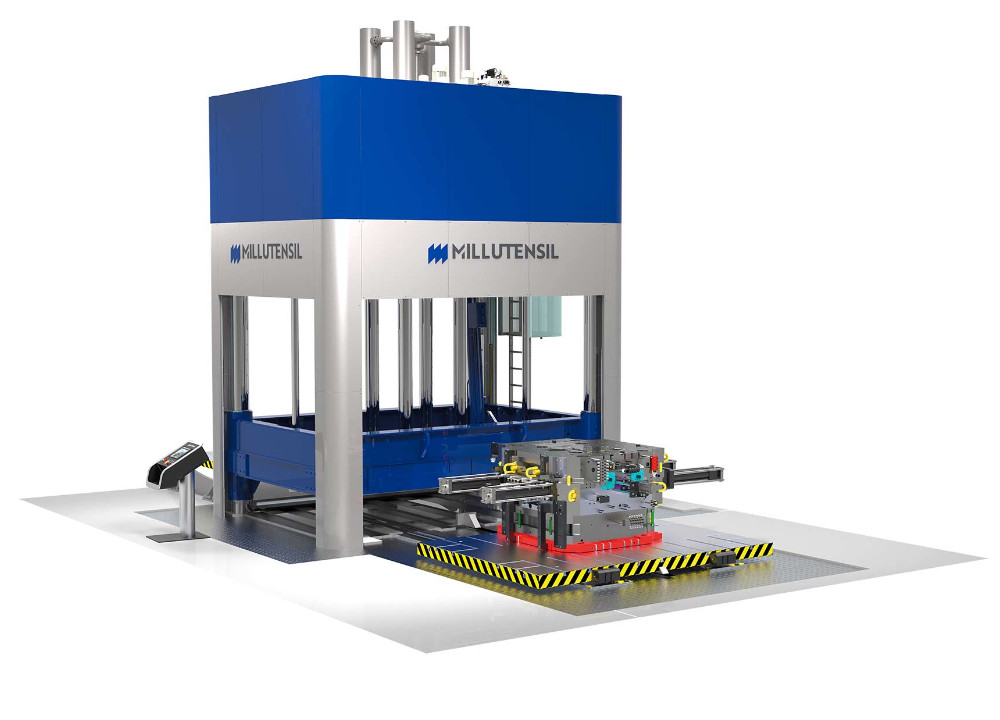
At the heart of Veronica’s argument is a simple observation: die casting dies are not like other tools. “Die casting dies have very specific design characteristics,” she explained. “Integrated hydraulic cylinders and their associated components increase the overall dimensions of the die and make handling, access and maintenance far more challenging. So the equipment used for die preparation has to accommodate not only the size of the die, but its whole configuration.”
Millutensil’s answer is the MIL Compact series, developed specifically for die casting and covering medium and large dies, including tooling used in demanding gigacasting applications. The machines provide a dedicated working environment for die assembly, inspection, spotting and maintenance — work that would otherwise tie up the production casting machine itself. “When these operations are carried out separately from the casting machine, the casting machine stays in production,” Veronica said. “That is where a die caster really begins to see the value.”
The defining feature is the tilting upper platen, which rotates through 180°. It gives operators access to both die halves, making inspection, spotting and maintenance practical even with bulky tooling configurations, and removing the need for unsafe, imprecise handling methods such as turning dies with overhead cranes.
Built for the gigacasting era
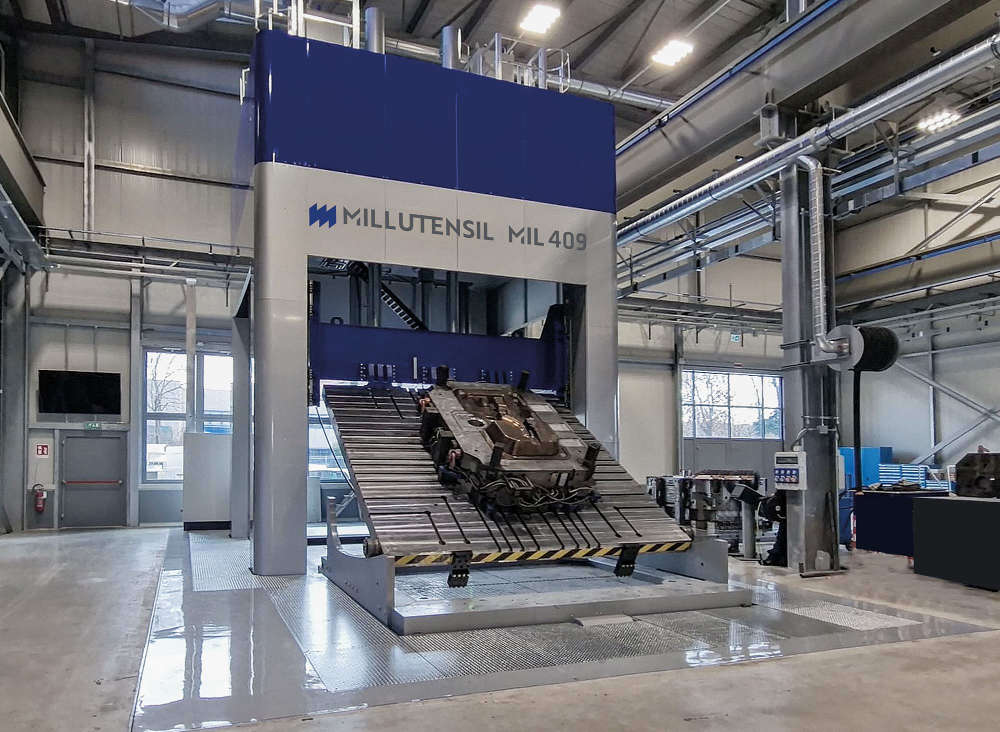
If the MIL Compact is Millutensil’s answer to today’s die casting dies, the GIGA Spotting Press MIL 409 is its answer to tomorrow’s. As the industry moves towards gigacasting single, very large structural castings that replace dozens of stamped and welded parts the dies required to produce them have grown to a scale few die shops have ever had to manage.
“The development of gigacasting, with increasingly large structural components and the dies required to produce them, further increases the need for dedicated die spotting and maintenance solutions,” Veronica Just said. “As die dimensions continue to increase, the equipment for die spotting has to evolve with them.”
The MIL 409 accommodates dies weighing up to 200 tonnes, with platen dimensions of 4 × 4 metres and more. First shown at BI-MU in Milan in 2024 and described by the company as the largest spotting press it has built, the machine stands around 11 metres tall and uses a patented tilting system to handle giga dies safely and precisely, providing a dedicated station for inspection, spotting, adjustment and maintenance.
“With its large working area and the ability to handle exceptionally heavy dies, the MIL 409 reflects how important specialised equipment has become for preparing and maintaining complex tooling outside the production casting machine,” she said.
What Millutensil hopes to hear in New Delhi
For Veronica Just, ALUCAST 2026 is less a product launch than a listening exercise. India’s aluminium die casting sector is expanding on the back of automotive lightweighting, electric mobility and rising export ambitions, and the dies coming into Indian plants are growing larger and more complex with each programme.
“ALUCAST is an opportunity to meet Indian die casting manufacturers, foundries and die makers and to understand their requirements for die spotting, adjustment and maintenance,” she said. “We are paying particular attention to medium and large dies, including those used in gigacasting. Every die shop has its own way of working, and our machines are built around that. We want to listen first.”
It is a fitting ambition for a company that has spent seventy years in the less-glamorous half of the casting story. The casting machine may make the part, but the die and the care that goes into it decide whether the part is right. In New Delhi this December, Millutensil Innovation will be making that case to an industry that is only just beginning to cast at giga scale. Millutensil Innovation will exhibit at ALUCAST 2026 in collaboration with PROTOS INDIA, 10 – 12 December 2026, Yashobhoomi (IICC), Dwarka, New Delhi. Machine Maker will be tracking Millutensil Innovation’s participation as part of its ongoing coverage of ALUCAST 2026, ahead of and during the show.