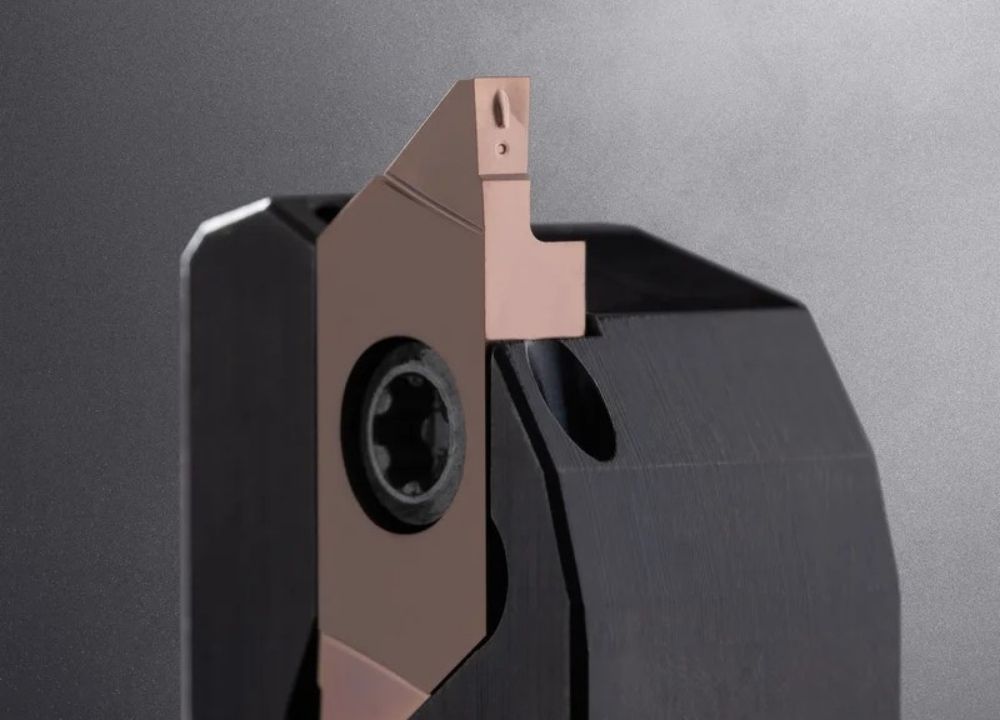
HORN has expanded its S274 tool system with a new range of sintered chip-breaking geometries, strengthening its solutions for grooving, parting-off and turning applications. The latest additions are designed to improve chip control, increase process reliability and deliver more economical machining, particularly on Swiss-type lathes.
The expanded portfolio introduces new precision-sintered chip-breaker geometries that support stable machining across a wide range of materials while helping manufacturers achieve higher productivity and lower material waste. The development reflects HORN’s continued focus on providing advanced tooling solutions that meet the changing needs of precision manufacturing.
As part of the expansion, HORN has introduced narrow grooving widths of 0.8 mm and 0.6 mm for its precision-sintered .1A chip-breaker geometry. These new inserts are designed for grooving and parting-off operations where reducing material loss is critical. Despite the narrow cutting widths, the geometry ensures reliable chip formation and smooth machining performance.
The .1A geometry is suitable for a wide range of materials and supports feed rates from 0.03 mm/rev to 0.12 mm/rev, providing manufacturers with greater flexibility across different production requirements. The new inserts are available as RS274 models and as RE274 variants equipped with a pressed-in threaded insert for RH274 toolholders. HORN offers both versions in its TH35 and IG35 carbide grades, delivering durability, longer tool life and consistent machining performance. The improved chip-breaker design enables better chip evacuation while reducing the risk of interruptions during machining.
In addition to the .1A geometry, HORN has introduced two new chip-breaker designs—.NF and .PR—to further expand the capabilities of the S274 system. The .NF geometry has been developed for grooving and longitudinal turning applications, while the .PR geometry is intended for back-turning operations. Both designs provide controlled chip formation and stable machining performance, making them particularly suitable for precision work on Swiss-type lathes.
The .NF and .PR geometries operate within a feed rate range of 0.02 mm/rev to 0.10 mm/rev and are compatible with a broad range of workpiece materials. Like the .1A series, they are available in TH35 and IG35 carbide grades, ensuring reliable performance across demanding production environments.
With these latest additions, HORN has significantly expanded the application range of the S274 tool system for manufacturers carrying out precision grooving and turning operations. The new chip-breaking geometries help improve machining stability, optimise chip control and reduce production costs while maintaining high levels of accuracy and productivity. The expanded portfolio provides manufacturers with greater flexibility to handle complex machining tasks efficiently, even in applications requiring very narrow grooving widths and high process reliability.